Snazzyway Insight: 10 Things Every Woman Should Know Before Starting an Online Fashion Business
Published by Snazzyway.com | India's Leading Women's Clothing & Lingerie Brand Since 2014 👗 Business & Fashion | ⏱ 9 min read |
🔖 Quick Summary
- Why online fashion is one of the best businesses for Indian women right now
- 10 critical things every woman must know before starting
- Real mistakes that kill fashion businesses in the first 6 months
- How inventory, pricing, and logistics decisions make or break you
- Honest Pros & Cons of starting an online fashion business in India
- Snazzyway Insight: Lessons from 12+ years and 4,000+ seller partnerships
- How to start smart — without risking your savings
- Frequently asked questions answered
Introduction: The Best Time to Start Is Right Now — But Start Smart
India's online fashion market is growing faster than almost any other ecommerce category. Women's clothing, lingerie, nightwear, and comfort wear are among the top-selling categories on every major platform — from Instagram to Meesho to independent websites.
And the most exciting part? Most of the sellers winning in this space today are women who started from home with limited capital and zero prior business experience.
But here is the truth nobody tells you upfront — for every woman who builds a successful online fashion business, there are five who quit within the first year. Not because they lacked passion or hard work. But because they did not know a few critical things before they started.
At Snazzyway, we have worked with 4,000+ sellers across India and globally since 2014. We have seen what works, what fails, and exactly where most new fashion entrepreneurs go wrong.
This article is our honest guide — 10 things every woman should know before starting an online fashion business in India. Read this before you spend a single rupee.
Why Online Fashion Is a Golden Opportunity for Indian Women Right Now
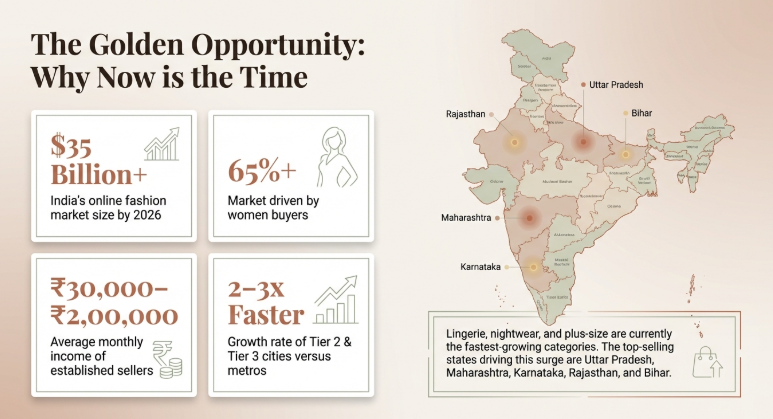
Before we get into the 10 things, let us quickly understand why this opportunity is real and why now is the right time.
| Metric | Number / Insight |
|---|---|
| India’s online fashion market size (2026) | $35 Billion+ |
| Women buyers driving fashion ecommerce | 65%+ |
| New fashion sellers entering market monthly | 50,000+ |
| Average monthly income of established sellers | ₹30,000 – ₹2,00,000 |
| Fastest growing categories | Lingerie, Nightwear, Plus Size |
| Top selling states for women's fashion | Uttar Pradesh, Maharashtra, Karnataka, Rajasthan, Bihar |
| Tier 2 & Tier 3 growth rate vs metros | 2–3× faster |
The opportunity is massive. But so is the competition. Which is exactly why knowing these 10 things before you start gives you a real edge over sellers who learn them the hard way.
Thing 1: Passion Is Not Enough — You Need a Business Model
This is the number one mistake new fashion sellers make. They love fashion, they have good taste, and they assume that is enough to build a business.
It is not.
A business model means knowing clearly: How will you source products? How will you price them? How will you deliver? How will you handle returns? How will you get paid?
Before you post your first product, you need answers to all five questions. The good news is these are all solvable — but they need to be solved before day one, not after.
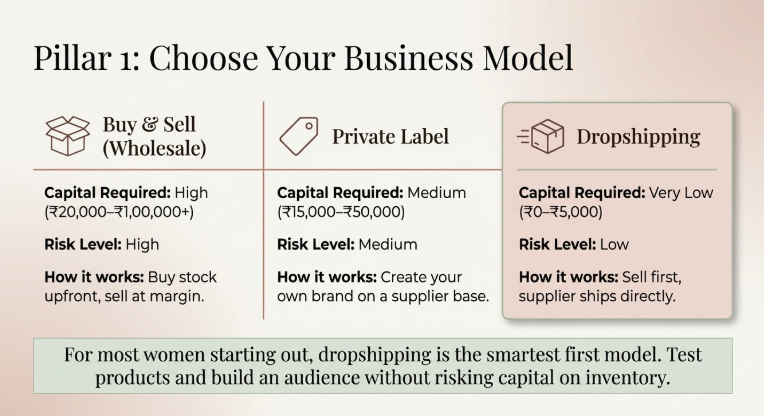
The three most common models for new online fashion sellers in India:
| Model | How It Works | Capital Required | Risk Level |
|---|---|---|---|
| Buy & Sell (Wholesale) | Buy inventory upfront and sell products with your margin | High (₹20,000 – ₹1,00,000+) | High |
| Dropshipping | Sell products first, supplier ships directly to customer | Very Low (₹0 – ₹5,000) | Low |
| Private Label | Create your own brand using supplier’s products and branding | Medium (₹15,000 – ₹50,000) | Medium |
For most women starting out, dropshipping is the smartest first model — you test products, build an audience, and learn the market without risking capital on inventory that may not sell.
Thing 2: Your Niche Is Your Biggest Competitive Advantage
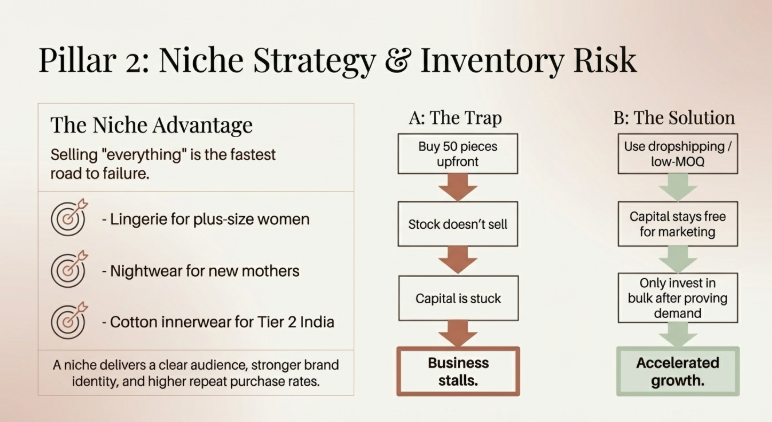
"I will sell all kinds of women's fashion" is the fastest road to failure.
The sellers who win are the ones who pick a niche and own it. Lingerie for plus size women. Nightwear for new mothers. Athleisure for working women. Cotton innerwear for Tier 2 India.
A niche gives you: a clear audience, better product selection, stronger brand identity, and much higher repeat purchase rates.
When Snazzyway started in 2014, we focused specifically on women's lingerie and innerwear — not all of fashion. That focus is a big reason why we became one of India's leading brands in this space.
Pick your niche before you pick your products.
Thing 3: Inventory Risk Can Kill Your Business Before It Starts
Buying too much stock too early is one of the most common ways new fashion businesses die.
You buy 50 pieces of a kurta set because you love it. It does not sell. Your capital is stuck. You cannot buy new products. Business stalls.
The solution: Start with a dropshipping or low-MOQ (minimum order quantity) model. Test products with small quantities before committing to bulk. Only invest in inventory after a product has proven it sells.
At Snazzyway, our seller partners do not carry inventory at all in the beginning. They list our catalog, take orders, and we ship directly — so their capital stays free for marketing and growth.
Thing 4: Pricing Is a Strategy, Not a Guess
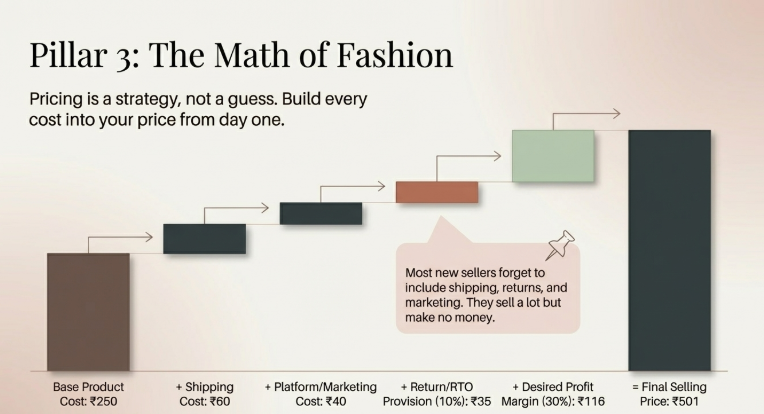
Most new sellers either price too low (and make no profit) or too high (and make no sales). Both kill the business.
Here is the simple pricing formula every fashion seller should use:
| Component | Example Cost |
|---|---|
| Product Cost | ₹250 |
| Shipping Cost | ₹60 |
| Platform / Marketing Cost | ₹40 |
| Return / RTO Provision (10%) | ₹35 |
| Desired Profit Margin (30%) | ₹116 |
| Selling Price | ₹501 |
Most new sellers forget to include shipping, returns, and marketing in their cost calculation. Then they wonder why they are "selling a lot but making no money."
Build every cost into your price from day one. Your business will thank you.
Thing 5: Platform Choice Determines Your Customer Type
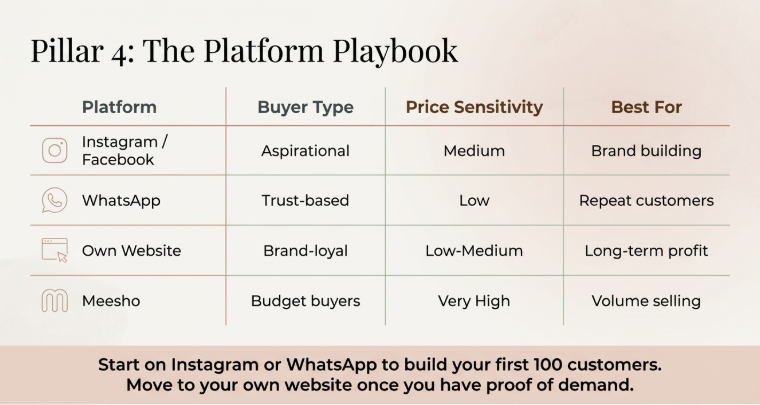
Where you sell shapes who buys from you — and at what price.
| Platform | Buyer Type | Price Sensitivity | Best For |
|---|---|---|---|
| Instagram / Facebook | Aspirational buyers | Medium | Brand building |
| Meesho | Budget buyers | Very High | Volume selling |
| Your Own Website | Brand-loyal buyers | Low – Medium | Long-term profit |
| Trust-based buyers | Low | Repeat customers | |
| Amazon / Flipkart | Deal seekers | High | Scale with competition |
Snazzyway's recommendation: Start on Instagram or WhatsApp to build your first 100 customers. Then move to your own website once you have proof of demand. Meesho is great for volume but very hard to build brand loyalty on.
Thing 6: Product Photography Can Make or Break Your Sales
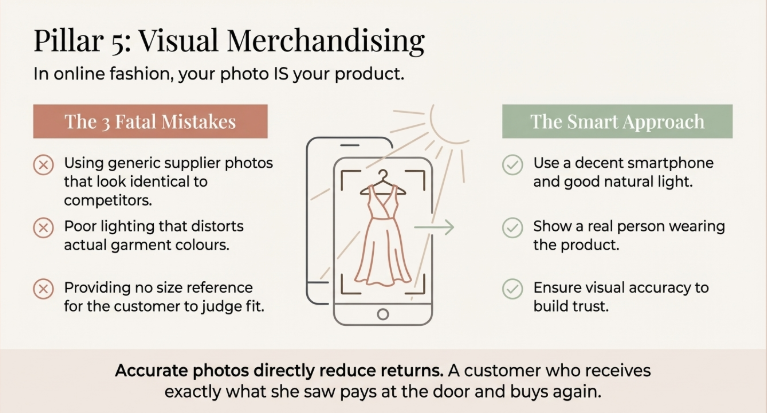
In online fashion, your photo IS your product. If the photo is bad, the product does not sell — no matter how good it actually is.
The three most common photography mistakes new sellers make:
- Using supplier photos that every other seller also uses — no differentiation
- Poor lighting that makes colors look wrong — leads to returns
- No size reference in the photo — customers cannot judge fit
You do not need a professional photographer to start. A decent smartphone, good natural light, and a real person wearing the product will outperform studio shots for most fashion categories in India.
One more thing: Accurate photos reduce returns. A customer who receives exactly what she saw in the photo pays at the door and buys again. A customer who feels misled never comes back.
✅ Pros & Cons — Starting an Online Fashion Business in India
| ✅ Pros | ⚠️ Cons to Prepare For |
|---|---|
| Very low startup cost possible | High competition in most categories |
| Huge and growing market in India | Returns and RTO can hurt margins |
| Work from home — full flexibility | Customer trust takes time to build |
| Multiple platforms available | Platform algorithm changes affect reach |
| Repeat purchase category — loyal buyers | Sizing issues common in fashion |
| Dropshipping removes inventory risk | Courier and logistics management needed |
| Tier 2/3 India largely untapped | COD fraud risk for new sellers |
Thing 7: Returns and RTO Are Part of the Business — Manage Them, Not Fear Them
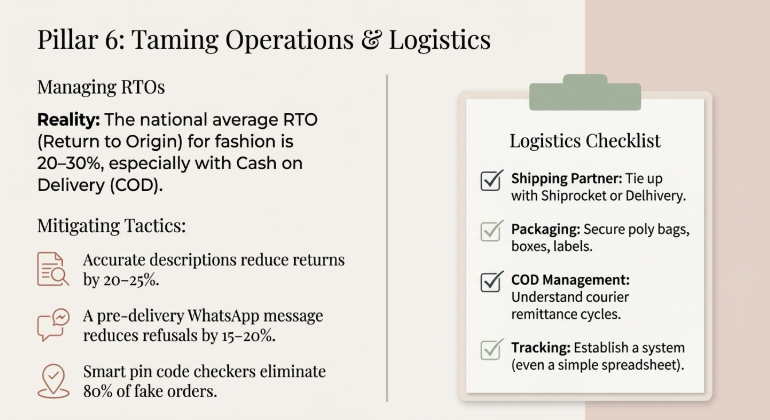
New sellers are often shocked by their first batch of returns. Some quit right there.
Do not quit. Returns are normal in fashion ecommerce — especially in India where COD is the dominant payment method. The national average RTO for fashion is 20–30%.
But here is what separates successful sellers from ones who quit: successful sellers build systems to manage returns from day one.
- Accurate product descriptions reduce returns by 20–25%
- A pre-delivery WhatsApp message reduces refusals by 15–20%
- Smart pin code management reduces fake orders by 80%
Snazzyway manages RTO at just 3–7% — and our seller partners benefit from these systems the moment they start working with us.
💡 Snazzyway Insight: What We Wish Someone Had Told Us in 2014
"When we started Snazzyway in 2014, we made almost every mistake on this list. We bought too much inventory. We priced without calculating returns. We used bad photos. We did not understand our customer deeply enough."
"What saved us was not talent or luck. It was the willingness to learn fast, fix fast, and keep going."
Here are the three things the Snazzyway team wishes someone had told us on day one:
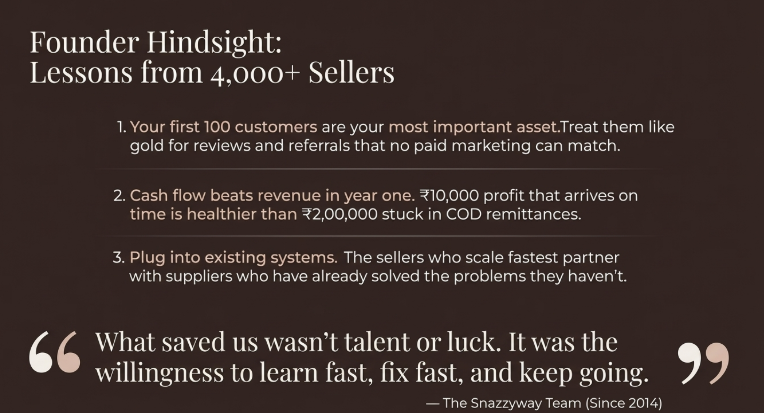
1. Your first 100 customers are your most important business asset. Treat them like gold. Reply fast. Deliver perfectly. Follow up personally. Those 100 customers will give you reviews, referrals, and repeat orders that no paid marketing can match.
2. Cash flow is more important than revenue in the first year. A business with ₹50,000 monthly revenue and ₹10,000 profit that arrives on time is healthier than one with ₹2,00,000 revenue and cash stuck in COD remittances and unsold inventory.
3. Pick a supplier who has already solved the problems you have not. In 12+ years of working with 4,000+ sellers, the ones who scaled fastest were the ones who plugged into a system that already worked — instead of building everything from scratch. That is why partnering with a trusted women's fashion dropshipping platform in India is one of the smartest first moves any new seller can make.
— The Snazzyway Team, Delhi (Since 2014)
Thing 8: Customer Trust Is Built Through Consistency, Not Discounts
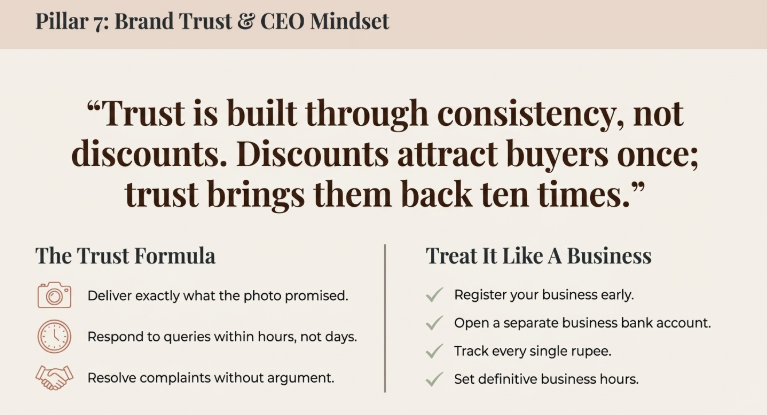
New sellers often think the way to win customers is to offer the lowest price or the biggest discount.
Wrong.
Customers in India buy from sellers they trust. And trust is built through:
- Delivering exactly what was shown in the photo
- Responding to queries within hours, not days
- Resolving complaints without argument
- Being consistent — same quality, same communication, every single order
Discounts attract buyers once. Trust brings them back 10 times.
Thing 9: Understand Your Logistics Before You Take Your First Order
This is where most new sellers get a nasty surprise. They take 50 orders, pack them excitedly, and then realize they have no idea how to ship, track, or handle returns properly.
Basic logistics checklist for new fashion sellers:
| Task | What You Need |
|---|---|
| Shipping partner | Tie up with Shiprocket, Delhivery, or similar |
| Packaging material | Poly bags, boxes, tape, labels |
| Return policy | Clear, written, communicated upfront |
| COD management | Know your courier's remittance cycle |
| Tracking system | Even a simple spreadsheet works initially |
| Pin code checker | Verify deliverability before accepting orders |
Alternatively — and this is what thousands of Snazzyway seller partners do — you skip all of this by working with a supplier who handles shipping, tracking, and returns for you from day one.
Thing 10: Treat It Like a Business from Day One
The biggest mindset mistake new sellers make is treating their fashion business like a hobby until "it gets serious."
Register your business early. Open a separate bank account. Track every rupee in and out. Set business hours. Create a proper catalog. Build a brand name.
The sellers who scale from ₹10,000 to ₹1,00,000 per month are not necessarily more talented — they are more serious. They treat their business with the same discipline and respect as any job or investment.
Fashion is one of the most rewarding businesses a woman can build in India today. But it rewards the ones who take it seriously first.
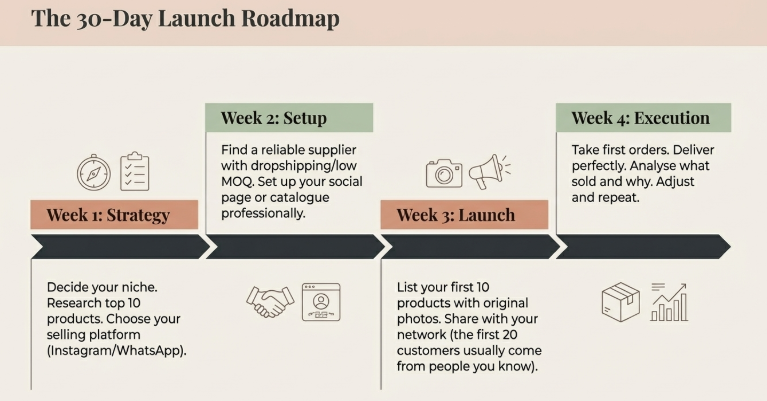
How to Actually Start — Your First 30 Days Action Plan
| Week | Action |
|---|---|
| Week 1 | Decide your niche. Research the top 10 products in that niche. |
| Week 1 | Choose your selling platform — Instagram or WhatsApp to start. |
| Week 2 | Find a reliable supplier with low MOQ or a dropshipping option. |
| Week 2 | Set up your Instagram page or WhatsApp catalog professionally. |
| Week 3 | List your first 10 products with original photos and accurate descriptions. |
| Week 3 | Share with your network — the first 20 customers usually come from people you know. |
| Week 4 | Take your first orders, deliver perfectly, and ask customers for reviews. |
| Week 4 | Analyze what sold, what didn’t, and why. Adjust and repeat. |
The Smart Shortcut: Start with a Proven Supply Chain
Everything in this article becomes dramatically easier when you start with a supplier who has already solved inventory, quality, shipping, and returns at scale.
This is exactly the model that has helped thousands of women across India build successful fashion businesses — by partnering with India's leading women's clothing and lingerie dropshipping supplier instead of trying to build every system from scratch.
With 12+ years of experience, 4,000+ active seller partnerships, premium and plus size designs, and pan-India free shipping — Snazzyway's B2B infrastructure is built specifically to help new and growing fashion sellers succeed faster.
Conclusion: You Are More Ready Than You Think — Start Smart
Every successful fashion entrepreneur in India started exactly where you are right now — with an idea, a dream, and a lot of unanswered questions.
The difference between those who made it and those who did not comes down to one thing: they started with knowledge, not just enthusiasm.
You now have that knowledge. The 10 things in this article are the foundation of every successful online fashion business in India. Apply them from day one and you are already ahead of 80% of sellers who will start this month.
The market is ready. The opportunity is real. And with the right supply chain behind you — there is no reason your fashion business cannot be exactly what you dream it to be.
❓ Frequently Asked Questions (FAQ)
Q1. How much money do I need to start an online fashion business in India? You can start with as little as ₹0–₹5,000 using a dropshipping model where you sell first and the supplier ships directly. If you choose to buy inventory upfront, a starting budget of ₹20,000–₹50,000 is recommended for a small but viable stock.
Q2. Which is the best platform to sell fashion online in India for beginners? Instagram and WhatsApp are the best starting points for new sellers because they allow you to build personal trust with buyers without platform fees. Once you have consistent sales, moving to your own website gives you the best long-term margins and brand control.
Q3. Do I need to register my business before I start selling fashion online? Technically you can start selling without registration, but registering as a sole proprietor or getting a GST number opens up more platform options, better payment gateway access, and gives your business a professional image. It is recommended to register within your first 3 months.
Q4. How do I find reliable suppliers for women's fashion in India? Look for suppliers with proven track records, real seller reviews, clear return policies, and transparent pricing. Snazzyway has been supplying women's lingerie and fashion to 4,000+ sellers since 2014 with free pan-India shipping and an industry-best 3–7% RTO rate.
Q5. What is the most profitable women's fashion category to sell in India? Lingerie, innerwear, nightwear, and plus size fashion are among the most profitable categories due to high repeat purchase rates, low average order value barriers, and strong demand in Tier 2 and Tier 3 cities. These categories also have very low seasonal dependency compared to ethnic wear or outerwear.
Q6. How do I handle returns and RTO as a new fashion seller? Start by using accurate product photos and detailed size charts to reduce mismatched expectations. Send a WhatsApp confirmation message after every order and a reminder before delivery. For COD orders, verify high-value or high-risk pin code orders before dispatch. These steps alone can reduce RTO by 30–40%.
Q7. Can I run an online fashion business from a small town in India? Absolutely. Some of India's fastest-growing fashion sellers are based in Tier 2 and Tier 3 cities. With dropshipping, you do not need a physical store or large warehouse — just a smartphone, internet connection, and a reliable supplier. Location is not a barrier in online fashion.
Q8. How long does it take to start making consistent income from an online fashion business? Most sellers who start seriously and follow a structured approach begin seeing consistent monthly income within 3–6 months. Sellers who partner with established supply chains and focus on customer experience often reach ₹30,000–₹50,000 monthly revenue within their first 6 months.
You must login to post a comment.

Related Articles
You may also like these posts
What 10,000+ Reviews Taught Us in 12 Years
Aug 09, 2026
Why We Rebuilt the Snazzyway Review System
Aug 09, 2026
How Snazzyway Works — A Complete Guide for New Dropshipping Sellers in India
Mar 30, 2026
How Snazzyway Has Supported Indian Fashion Sellers for 12 Plus Years
Mar 30, 2026
How Indian Housewives Are Earning ₹30,000 a Month Selling Online From Home
Mar 30, 2026