7 Reasons Your Shopify Lingerie Store Isn't Converting (And How to Fix It)
✍️ Snazzyway Editorial Team | ⏱️ 9 min read
Why is my Shopify lingerie store not converting?
Most Shopify lingerie stores fail to convert not because of bad products, but because of trust gaps — poor product photos, missing size information, slow load speed, and weak supplier credibility. Fixing these seven specific issues can increase your store's conversion rate significantly without spending more on ads.
📋 Quick Summary
- Low conversion on a Shopify lingerie store is almost always fixable — it is rarely about the product itself
- The seven most common reasons are covered in this post with specific, actionable fixes for each
- Snazzyway has worked with 4,000+ sellers across India since 2014 — the patterns in this post come from real seller data
- Internal fixes like product page quality, trust signals, and size guides matter more than ad spend
- Sellers using a reliable Indian supplier with quality products and fast fulfillment convert significantly better
- This post includes a comparison table, pros and cons, real seller insights, and a full FAQ section
Introduction
You set up your Shopify store. You found products. You ran some ads. People are clicking — but nobody is buying.
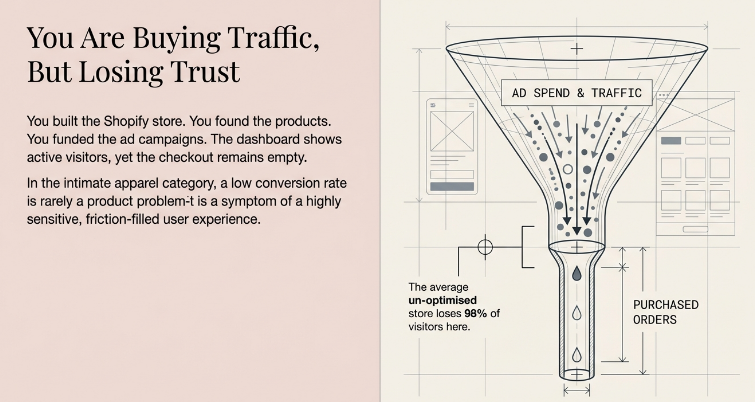
This is one of the most frustrating situations in ecommerce. Traffic without conversions means you are spending money and getting nothing back. And in the lingerie category specifically, the conversion challenge is real. Customers are making a very personal purchase. They need to trust your store completely before they hand over their payment details.
After 12+ years in the women's lingerie and fashion business and working closely with 4,000+ active Shopify sellers across India, Europe, and the USA, we have seen the same conversion problems appear again and again. The good news is that almost every one of them is fixable — often without spending a single rupee on more ads.
Here are the seven reasons your Shopify lingerie store is not converting, and exactly how to fix each one.
Reason 1 — Your Product Photos Are Killing Trust
In lingerie, the photo is the product. Customers cannot touch the fabric, check the stitching, or try it on. The image is the only thing they have to make a decision. If your photos are blurry, poorly lit, shot against a messy background, or simply copied from a supplier catalogue without any curation — customers leave.
This problem is especially common with sellers listing products like bra sets, and nightwear — categories where the visual detail of fabric texture and fit directly influences the buying decision.
The fix: Use clean, high-resolution images with a minimum of three angles per product — front, back, and a detail shot showing fabric texture. White or neutral backgrounds work best for building product trust. Lifestyle images showing the product worn in a real setting help customers visualise how it looks and fits on an actual body.
If you are sourcing from a supplier, ask specifically whether they provide HD product images and video content. At Snazzyway, every product in our catalogue comes with high-resolution images and full HD video — so sellers never have to shoot their own content from scratch.
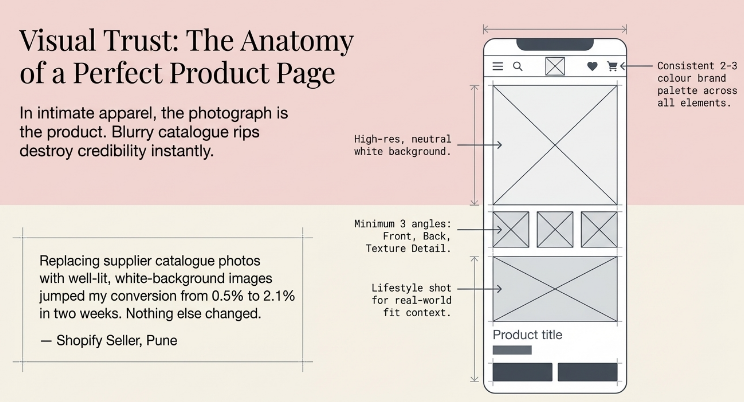
📍 From Our Seller Network "I was running Facebook ads with a decent budget but my conversion rate was under 0.5%. The moment I replaced supplier catalogue photos with better-lit, white-background images, my conversion jumped to 2.1% within two weeks. Nothing else changed." — Shopify Seller, Pune
Reason 2 — No Size Guide or Confusing Size Information
Lingerie is one of the most size-sensitive categories in all of fashion. A customer who is not 100% certain about sizing will not buy. She will abandon the cart and go to a store where the information is clearer.
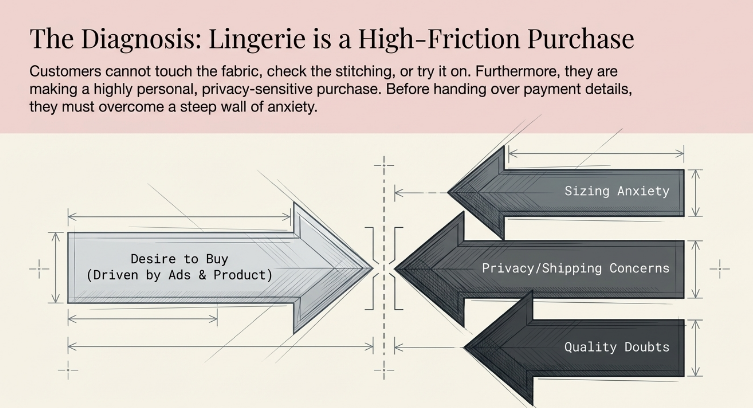
This is particularly critical when selling categories like shapewear and bra sets where fit directly affects comfort and function. Most Shopify lingerie stores either have no size guide at all or have a generic one that does not match their actual products. This single issue is responsible for a large percentage of abandoned carts in this category.
The fix: Create a size guide specific to your products — not a generic global chart. Include measurements in centimetres and inches. Add a "how to measure yourself" section with a simple diagram. If you sell multiple fabric types, note whether a product runs small, true to size, or large. Place the size guide link directly on every product page — not buried in a menu.
| Size Guide Element | Impact on Conversion | Why It Matters |
|---|---|---|
| Measurements in cm and inches | High | Covers both metric and imperial preferences, reducing confusion globally |
| How to measure yourself guide | High | Removes biggest hesitation by helping customers choose the right size |
| Fabric-specific sizing notes | Medium | Builds expert credibility and sets accurate expectations |
| Size guide link visible on product page | High | Ensures users see it without scrolling, increasing usage and reducing drop-offs |
| Customer photos by size | Very High | Real body representation builds trust and significantly improves conversions |
Reason 3 — Your Store Has No Trust Signals
Would you buy lingerie from a website you had never heard of, with no reviews, no contact information, no return policy, and no brand story? Nobody would.
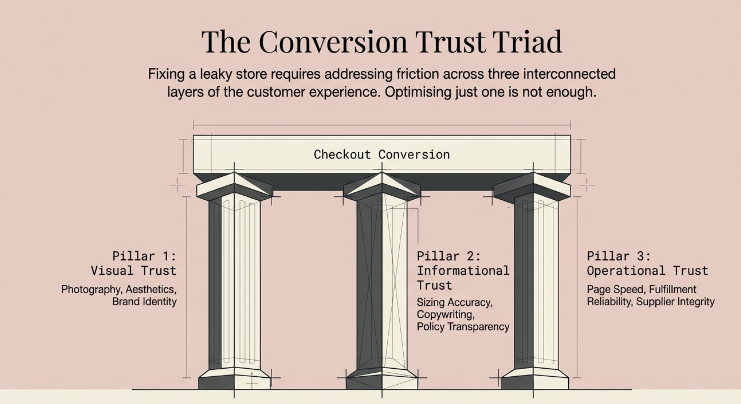
Yet thousands of Shopify lingerie stores launch with exactly this setup. No reviews. No about page. No visible contact details. No trust badges near the checkout button. Customers arrive, feel uncertain, and leave.
The fix: Add these trust elements before you spend a single rupee on ads:
- A visible return and exchange policy linked from every product page
- A real contact email or WhatsApp number in the header or footer
- An About page that explains who you are and why you sell this product
- Star ratings and reviews on product pages — even 5 to 10 reviews make a measurable difference
- Trust badges near the Add to Cart button — "Secure Checkout," "Easy Returns," "Discreet Packaging"
Discreet packaging is especially important in the lingerie category in India. Many customers are concerned about privacy. If your store clearly states that orders are shipped in plain, unmarked packaging, your conversion rate in this category will improve noticeably.
🔍 Snazzyway Insight
Across our seller network, stores that display a clear discreet shipping policy on their product pages consistently show 15 to 25% higher add-to-cart rates compared to stores without this information. This is specific to the Indian lingerie market — it is a trust signal that matters more here than in most Western markets.
We document patterns like this from thousands of real seller accounts. If you want to understand what separates stores that scale from ones that stall, read what 4,000 sellers taught us about success in the women's clothing business in India — it covers pricing, product selection, and trust patterns across markets.
Reason 4 — Slow Page Load Speed
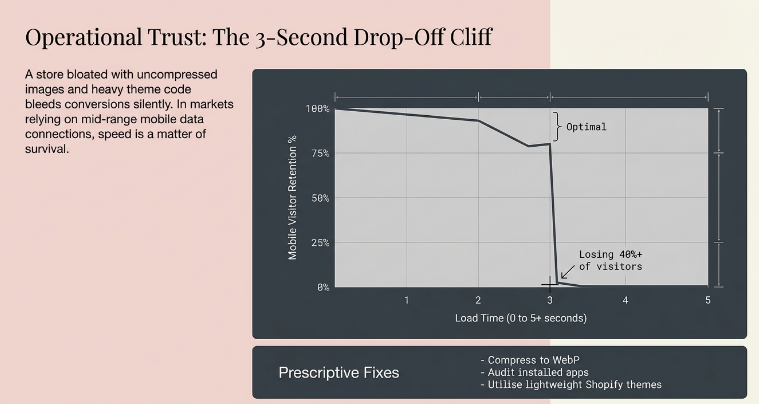
This one is technical but critical. If your Shopify store takes more than 3 seconds to load on a mobile device, you are losing more than half your potential customers before they even see your product.
In India, a large percentage of online shoppers browse on mobile with mid-range data connections. A store bloated with large uncompressed images, too many installed apps, and heavy theme code will load slowly and bleed conversions silently — with no obvious symptom other than low sales.
The fix:
- Compress all product images before uploading — use WebP format where possible
- Audit your installed Shopify apps and remove any you are not actively using
- Choose a lightweight, fast-loading Shopify theme — avoid themes packed with animations and heavy scripts
- Test your store using Google PageSpeed Insights and follow its specific recommendations
| Page Load Time | Estimated Conversion Impact | Why It Matters |
|---|---|---|
| Under 2 seconds | Optimal | Minimal drop-off; users stay engaged and browsing |
| 2 to 3 seconds | Acceptable | Minor drop-off, mainly on slower connections |
| 3 to 5 seconds | Significant | Losing 40%+ of mobile visitors due to impatience |
| Over 5 seconds | Critical | Most users leave before the page fully loads |
Reason 5 — Your Product Descriptions Are Generic and Say Nothing
"Sexy lingerie set. Available in multiple colours. High quality fabric." This kind of description tells the customer nothing useful and does nothing for your search rankings.
Generic descriptions come from sellers who copy-paste directly from a supplier catalogue or rush through the listing process to get products live quickly. Both result in the same outcome — low trust, low conversion, and zero organic search traffic.
The fix: Write product descriptions that answer the three questions every lingerie buyer has before purchasing:
- What does this feel like against my skin?
- How will this fit my body type?
- What is this for — daily wear, gifting, a special occasion?
Mention the fabric type specifically. Note whether it runs small or large. For products like silk satin lingerie mention the occasion it is suited for — gifting, honeymoon, anniversary — because customers in these subcategories are often buying with a specific purpose in mind. Add care instructions. These details signal genuine product knowledge and build the kind of trust that converts browsers into buyers.
Pros and Cons of Writing Custom Product Descriptions
Pros
- Ranks in Google for specific fabric, style, and occasion-based searches
- Builds customer trust — shows you understand your product deeply
- Reduces returns because customers have accurate expectations before buying
- Differentiates your store from dozens of others selling identical products from the same supplier
Cons
- Time-consuming if you have a large catalogue
- Requires product knowledge — a learning curve for brand new sellers
- Descriptions need updating when products are discontinued or restocked in a different fabric
Even writing detailed descriptions for your top 20 best-selling products first will have a measurable impact on conversion before you scale to the full catalogue.
Reason 6 — You Are Using an Unreliable Supplier
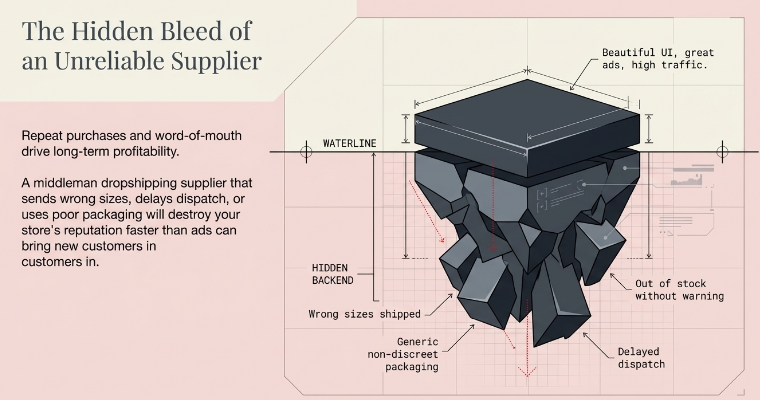
This one affects conversion indirectly but powerfully. If your supplier sends wrong sizes, delays shipments, uses poor packaging, or ships products that look nothing like the photos — your customers will not return, will not leave positive reviews, and will actively warn others away.
Repeat purchases and word of mouth are what make a Shopify store profitable over time. A bad supplier destroys both, often before you even realise what is happening.
The fix: Audit your supplier against these specific points before you scale:
| Supplier Quality Factor | What to Check | Why It Matters |
|---|---|---|
| Product consistency | Does the product match the photo every single time? | Prevents returns, builds trust, and ensures repeat purchases |
| Shipping speed | What is the average dispatch and delivery timeline? | Faster delivery improves customer satisfaction and reduces cancellations |
| Packaging quality | Is it discreet, secure, and presentable on arrival? | Impacts first impression and reduces damage-related complaints |
| Return handling | How does the supplier manage damaged or wrong items? | Smooth returns protect your brand reputation and customer trust |
| Inventory stability | Are products going out of stock without warning? | Avoids order cancellations and negative platform metrics |
| Communication | Do they respond quickly when something goes wrong? | Critical for resolving issues and maintaining operational control |
If you are currently on an unreliable supplier and considering switching, understanding how to connect your Shopify store with an Indian fashion supplier is the right starting point. That guide covers exactly what to look for in a supplier integration, how to evaluate reliability before committing, and the technical steps to connect your store once you have made a decision.
Switching to a manufacturer-led supplier — one that controls its own production, inventory, and fulfillment — removes most of these reliability problems at the source rather than trying to manage them after they occur.
🔍 Snazzyway Insight
In our experience working directly with sellers since 2014, the stores that consistently scale past ₹1 lakh per month almost always made one specific decision early — they switched to a reliable, manufacturer-direct supplier before scaling their ad spend. Stores built on aggregator or middleman suppliers hit a ceiling fast because quality inconsistency and shipping delays prevent the repeat purchases that make a store profitable.
Fashion ecommerce in India has grown 3x faster than offline retail in recent years — but only the sellers with solid backend operations are actually capturing that growth. The market opportunity is real. The differentiator is execution.
Reason 7 — Your Store Looks Like Everyone Else's
If your Shopify store uses a default theme, a generic logo, and the same product photos as every other seller sourcing from the same supplier — there is no reason for a customer to choose you specifically. In the lingerie category, brand identity matters enormously. Customers are making a personal, intimate purchase. They want to buy from a store that feels curated and trustworthy — not a generic store that looks like it was set up in an afternoon.
The fix: Invest in brand differentiation before you invest in ads. This does not require a large budget.
- Choose a store name and logo that feels premium, feminine, or playful depending on your niche
- Pick a consistent colour palette of two to three colours and use it everywhere — header, banners, packaging inserts
- Write a brand story that explains who your store is for and what makes it different
- Curate your product selection — do not list everything from the catalogue, list the best products for your specific target customer
For practical direction on what strong brand execution looks like, studying top Shopify fashion stores in India for design and branding inspiration gives you a clear sense of what separates forgettable stores from ones that build loyal, returning customer bases. The difference is almost always in the consistency of the brand experience — from the homepage to the packaging to the post-purchase message.
The Full Conversion Fix Checklist
Use this before running your next ad campaign. If any of these are missing from your store, fix them first.
| Fix | Priority | Time to Implement | Why It Matters |
|---|---|---|---|
| Replace low-quality photos with HD images | Critical | 1 to 2 days | First impressions drive conversions; poor visuals kill trust instantly |
| Add a detailed product-specific size guide | Critical | Half a day | Reduces sizing confusion and return rates |
| Add trust signals — reviews, policy, contact | Critical | Half a day | Builds credibility and reduces purchase hesitation |
| Compress images and audit apps for speed | High | 2 to 3 hours | Improves page load time and reduces drop-offs |
| Rewrite top 20 product descriptions | High | 2 to 3 days | Better copy increases conversion and perceived value |
| Audit and switch supplier if needed | High | 1 to 2 weeks | Fixes core issues like quality, shipping, and consistency |
| Invest in brand identity and store design | Medium | 1 week | Long-term trust, differentiation, and higher average order value |
How Snazzyway Helps Sellers Fix These Problems at the Root
Most of the conversion problems in this post trace back to one root cause — sellers trying to build a professional store on top of a weak product and supplier foundation.
When the supplier sends the wrong product, no amount of good copywriting fixes the review damage. When product photos are low resolution, no amount of ad spend compensates for the trust gap. This is why the fixes above all point toward the same underlying principle — get the foundation right first, then scale.
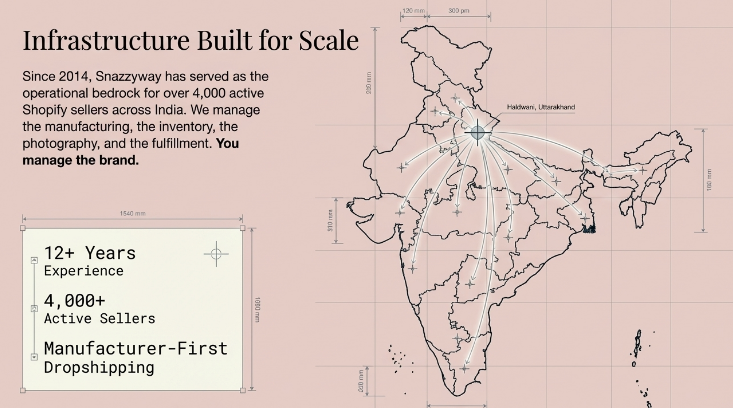
Snazzyway operates as a manufacturer-first dropshipping supplier with our own production unit in Haldwani, Uttarakhand. Every product — from our panties collection to our nightwear range — comes with HD images, consistent quality, discreet packaging, and pan-India shipping. Our sellers do not manage supplier fires. They focus on building their brand and driving traffic.
To understand the full scope of what this operational support looks like in practice, read about the platform supporting thousands of fashion resellers — it covers how our seller infrastructure works end to end.
And if you are ready to build a Shopify lingerie store on a foundation that actually supports conversion and growth, explore Snazzyway's dropshipping platform — India's leading women's clothing and lingerie dropshipping supplier since 2014, trusted by 4,000+ active sellers.
Frequently Asked Questions
Q1. What is a good conversion rate for a Shopify lingerie store in India? A healthy conversion rate for a Shopify lingerie store in India is between 1.5% and 3.5%. New stores typically start lower — around 0.5% to 1% — and improve as trust signals, reviews, and product page quality build up over time. If you are consistently below 1% with regular traffic, the seven issues in this post are the most likely cause.
Q2. Do I need professional photography to sell lingerie on Shopify? Not necessarily professional studio photography — but you do need high-quality, well-lit images on clean backgrounds. If your supplier provides HD product images, those can work very well. The key is that images must be sharp, true to colour, and show the product from multiple angles including a fabric detail shot.
Q3. How important are customer reviews for a Shopify lingerie store? Extremely important. Lingerie is a high-trust category. Even 5 to 10 genuine reviews on a product page can increase conversion meaningfully. Encourage early buyers to leave reviews by sending a follow-up WhatsApp or email message after delivery, and offer a small discount on their next order in return for honest feedback.
Q4. Should I offer free shipping on my Shopify lingerie store? Free shipping significantly reduces cart abandonment in India, where customers are sensitive to additional charges appearing at checkout. If your margins allow it, build the shipping cost into the product price and offer free shipping above a minimum order value — for example, free shipping on orders above ₹499 or ₹799.
Q5. How do I reduce returns on my Shopify lingerie store? The three biggest drivers of returns in lingerie are wrong size expectations, the product looking different from photos, and fabric feel not matching the description. Fix all three — with accurate size guides, honest product photography, and detailed fabric descriptions — and your return rate will fall significantly within a few months.
Q6. Is Shopify a good platform for selling lingerie in India? Yes. Shopify is one of the best platforms for selling lingerie in India because of its payment gateway options, mobile-optimised themes, and easy integration with Indian logistics and dropshipping suppliers. The platform itself is not the problem for most struggling stores — product page quality and supplier reliability are.
Q7. Can I sell lingerie on Shopify without holding any inventory? Yes. Dropshipping is the most practical model for new lingerie sellers in India. You list the products, the supplier handles manufacturing, packing, and shipping directly to your customer. The key is choosing a supplier who is a direct manufacturer — not a reseller or aggregator — so quality and pricing remain consistent as you scale your store.
You must login to post a comment.

Related Articles
You may also like these posts
What 10,000+ Reviews Taught Us in 12 Years
Aug 09, 2026
Why We Rebuilt the Snazzyway Review System
Aug 09, 2026
How Snazzyway Works — A Complete Guide for New Dropshipping Sellers in India
Mar 30, 2026
How Snazzyway Has Supported Indian Fashion Sellers for 12 Plus Years
Mar 30, 2026
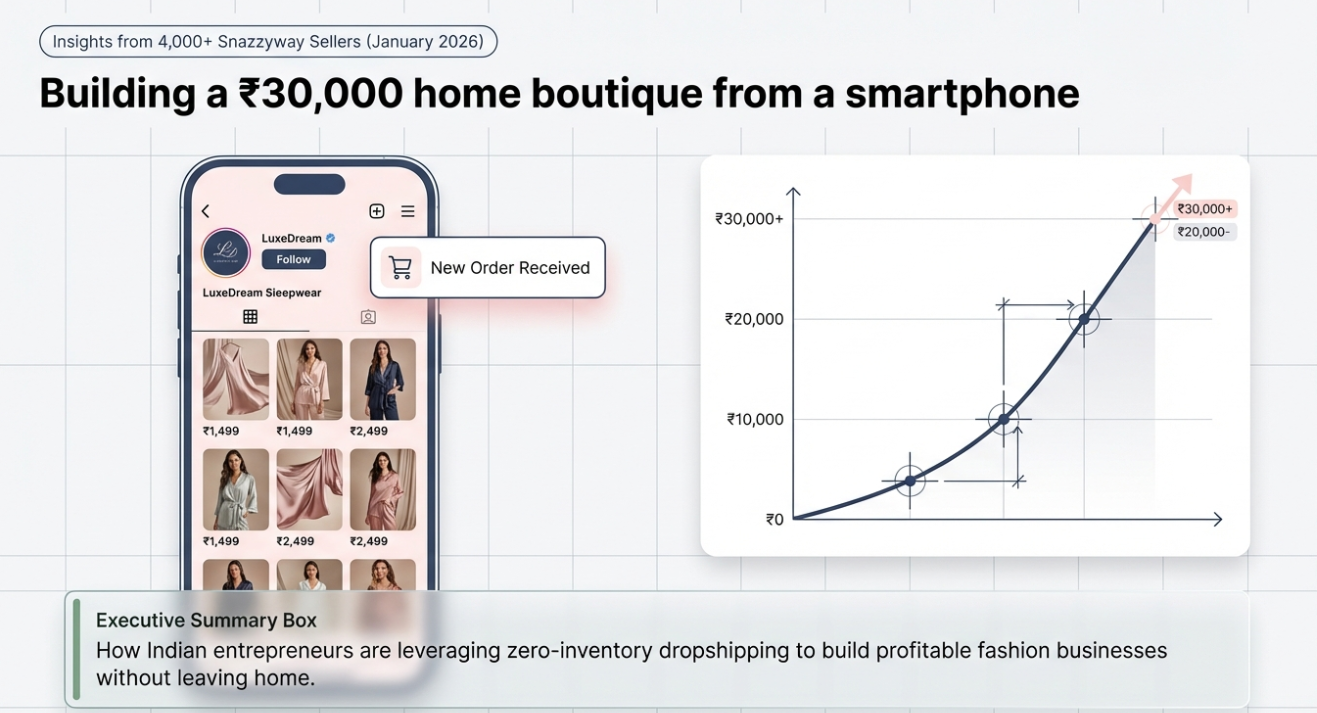
How Indian Housewives Are Earning ₹30,000 a Month Selling Online From Home
Mar 30, 2026