Snazzyway Data: How Fashion Ecommerce in India Grew 3X Faster Than Offline Retail
Published by Snazzyway.com | India's Leading Women's Clothing & Lingerie Brand Since 2014 📊 Data & Industry Insights | ⏱ 9 min read |
🔖 Quick Summary
- Hard data showing fashion ecommerce growing 3X faster than offline retail in India
- The key turning points that accelerated online fashion after 2016
- What Snazzyway witnessed firsthand across 12+ years and 4,000+ seller partnerships
- Category-wise breakdown of what is growing fastest
- How Tier 2 and Tier 3 India became the engine of this growth
- Honest Pros & Cons of this ecommerce boom for sellers and buyers
- Snazzyway Insight: Our authority view on what changed and what is coming
- Frequently asked questions answered
Introduction: The Numbers Do Not Lie — Indian Fashion Ecommerce Has Changed Forever
In 2014, when Snazzyway started operations in Delhi, the idea of buying lingerie or nightwear online was still considered unusual by most Indian women. The majority of fashion purchases happened in physical markets — local bazaars, mall stores, roadside shops.
Fast forward to 2026 — and the picture is unrecognisable.
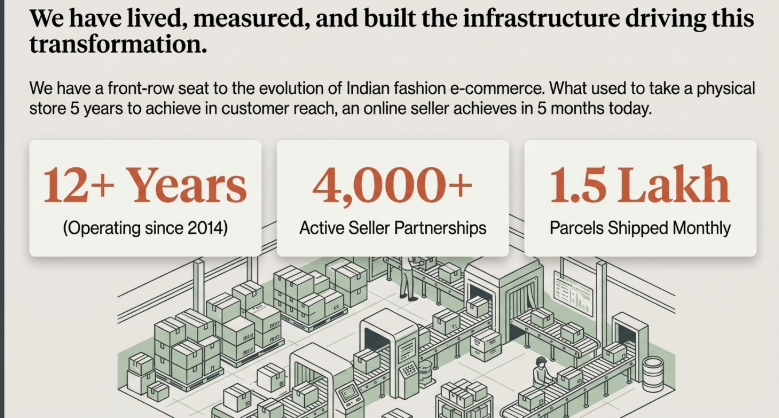
Indian fashion ecommerce is now growing at 3X the pace of offline retail. What used to take a physical store 5 years to achieve in terms of customer reach, an online fashion seller can achieve in 5 months today.
This is not an exaggeration. It is data. And at Snazzyway, we have a front-row seat to all of it.
With 12+ years in business, 4,000+ active seller partnerships across India and globally, and over 1.5 lakh parcels shipped every month — we have not just read about this growth. We have lived it, measured it, and built our entire infrastructure around it.
This article breaks down the data, the turning points, the driving forces — and what it all means for anyone building or thinking of building a fashion business in India today.
The Core Data — Fashion Ecommerce vs Offline Retail in India
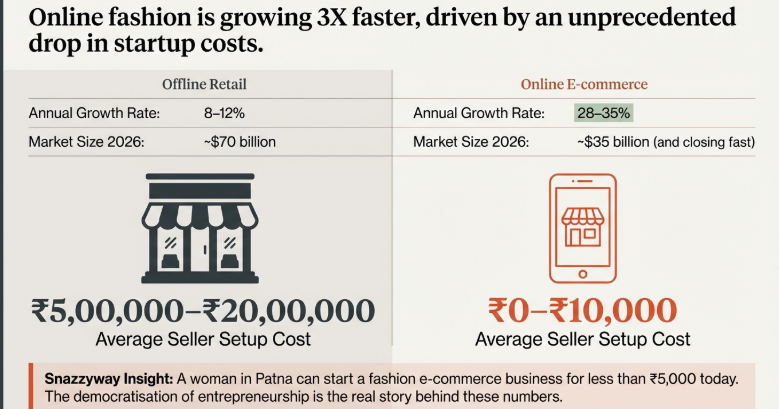
| Metric | Offline Fashion Retail | Online Fashion Ecommerce |
|---|---|---|
| Annual Growth Rate (2020–2026) | 8–12% | 28–35% |
| Market Size 2026 | ~$70 billion | ~$35 billion (and closing fast) |
| New Customer Acquisition Cost | Very High | Decreasing every year |
| Geographic Reach | City-dependent | Pan-India from day one |
| Average Seller Setup Cost | ₹5,00,000 – ₹20,00,000 | ₹0 – ₹10,000 |
| Tier 2/3 Penetration | Very Low | Very High & Growing |
| Customer Data & Insights | None | Rich & actionable |
| Returns Management | In-store | Systematic & scalable |
The gap is widening every year. And the most important number in that table is not the growth rate — it is the setup cost. A woman in Patna can start a fashion ecommerce business for less than ₹5,000 today. The same business offline would cost her ₹10–20 lakhs minimum. That democratisation of entrepreneurship is the real story behind these numbers.
Section 1: The Great Turning Points — What Changed After 2016
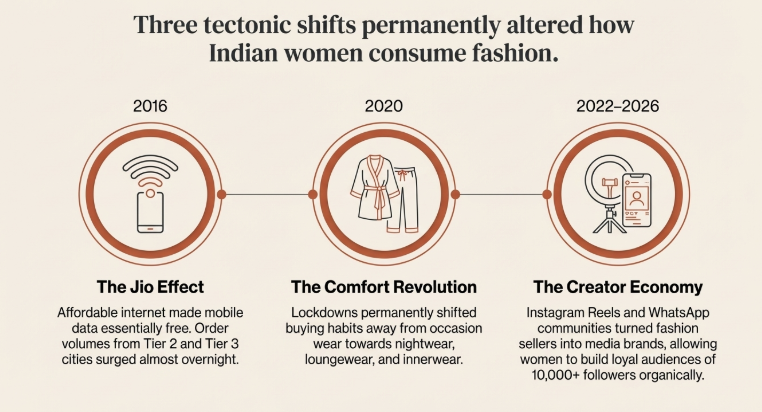
Snazzyway has been operating since 2014 — and we witnessed the inflection points of Indian fashion ecommerce firsthand. Here is what actually changed the game:
2016 — The Jio Effect Changed Everything
The single biggest turning point in Indian ecommerce history was not a platform launch or a policy change. It was affordable internet.
When Reliance Jio launched in September 2016 and made mobile data essentially free for hundreds of millions of Indians, the customer base for online fashion exploded almost overnight. Women in small towns and villages who had never shopped online before suddenly had fast internet in their hands.
At Snazzyway, we witnessed this directly. Order volumes from Tier 2 and Tier 3 cities began rising sharply from late 2016 — and they have not stopped since. Cities like Lucknow, Patna, Bhopal, and Surat went from being marginal markets to becoming some of our strongest seller hubs within 18 months.
This is also when smartphone-based selling took off — WhatsApp catalogs, Instagram pages, and Meesho-style reseller platforms all became viable because the infrastructure to support them suddenly existed everywhere in India.
2019–2020 — The Comfort Revolution
The second great turning point was less expected — a global pandemic.
When India went into lockdown in 2020, something profound happened to Indian fashion consumption. Women stopped buying occasion wear, party clothes, and formal attire. And they started buying comfort wear in huge volumes — nightwear, loungewear, innerwear, athleisure.
For Snazzyway, this was a defining moment. Our core categories — lingerie, nightwear, and comfort fashion — saw demand surge in ways we had never seen before. Sellers who had been doing ₹30,000 monthly were suddenly doing ₹1,00,000+.
The comfort fashion revolution did not reverse when lockdowns ended. It became permanent. Indian women had discovered the value of quality innerwear and nightwear — and they were not going back to ignoring it.
2022–2026 — The Creator Economy Meets Fashion
The third turning point is still happening right now. Instagram Reels, YouTube Shorts, and WhatsApp communities have turned every fashion seller into a potential media brand.
Women who would never have been able to afford advertising in 2015 are now building audiences of 10,000–1,00,000 followers through consistent, authentic content — and converting that audience into paying customers.
This has made fashion one of the most accessible and scalable businesses for women across India — regardless of city, budget, or background.
Section 2: Category-Wise Growth — What Is Selling Fastest
Not all fashion categories are growing equally. Here is the data on what is actually moving fastest in Indian ecommerce:
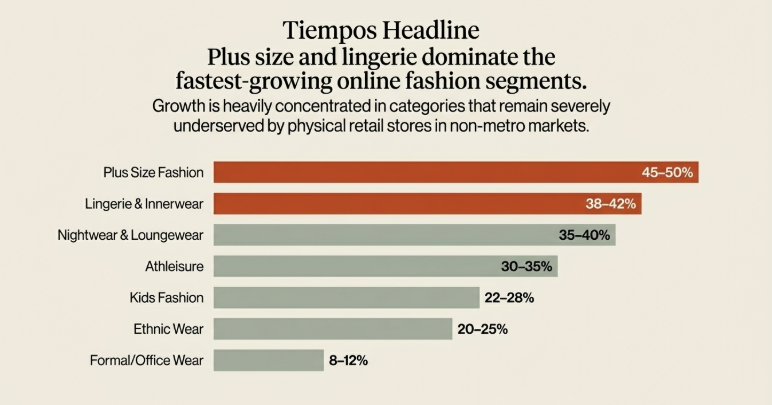
| Category | Online Growth Rate (2020–2026) | Key Driver |
|---|---|---|
| Lingerie & Innerwear | 38–42% annually | Quality access gap in Tier 2/3 |
| Nightwear & Loungewear | 35–40% annually | Post-2020 comfort revolution |
| Plus Size Fashion | 45–50% annually | Massively underserved market |
| Athleisure | 30–35% annually | Fitness culture + work from home |
| Ethnic Wear | 20–25% annually | Cultural demand + gifting |
| Kids Fashion | 22–28% annually | Rising disposable income |
| Formal / Office Wear | 8–12% annually | Work-from-home reducing demand |
The standout numbers are plus size fashion at 45–50% annual growth and lingerie at 38–42%. Both categories share a common factor — they are severely underserved in offline retail across most of India. Online is not just growing faster in these categories — it is the only meaningful channel for quality products.
This is why Snazzyway's catalog focuses so heavily on premium and plus size lingerie and nightwear. We built our product range around where the real, underserved demand exists — not just where the easy market is. Staying updated on the top lingerie trends retailers are stocking in 2026 is essential for any seller who wants to stay ahead of this curve.
Section 3: The Geography of Growth — Why Tier 2 India Is the Engine
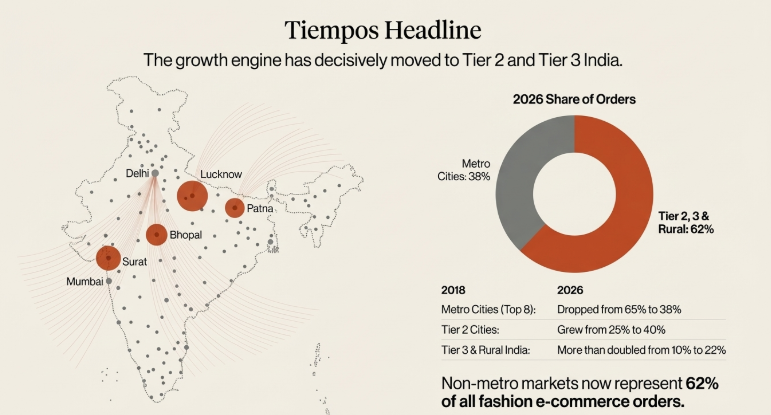
Metro cities — Delhi, Mumbai, Bangalore, Hyderabad — were the early leaders of Indian fashion ecommerce. But from 2018 onwards, the growth engine shifted decisively to smaller cities.
| Geography | Share of Fashion Ecommerce Orders (2018) | Share (2026) |
|---|---|---|
| Metro Cities (Top 8) | 65% | 38% |
| Tier 2 Cities | 25% | 40% |
| Tier 3 & Rural India | 10% | 22% |
Tier 2 cities went from 25% to 40% of all fashion ecommerce orders in just 8 years. Tier 3 and rural India more than doubled their share. Meanwhile metros, despite growing in absolute terms, now represent less than 40% of the market.
This is the structural shift that is defining Indian fashion ecommerce in 2026 — and it is being driven by women who are simultaneously the customers and the sellers in these markets.
For a deeper look at why Tier 2 women are leading this charge as fashion entrepreneurs, our detailed analysis of why Tier 2 India women are becoming fashion resellers faster than metro cities tells the full story with data and real seller insights.
✅ Pros & Cons — The Fashion Ecommerce Boom for Indian Sellers
| ✅ Opportunity for Sellers | ⚠️ Challenges to Navigate |
|---|---|
| Massive and still-growing market | Increasing competition every year |
| Very low startup cost | Returns and RTO management critical |
| Pan-India reach from day one | Platform algorithm dependency |
| Tier 2/3 markets largely untapped | Logistics reliability varies by pin code |
| Multiple revenue channels available | COD cash flow management needed |
| Creator economy amplifies reach for free | Customer trust takes time to build |
| Dropshipping eliminates inventory risk | Quality control essential for retention |
💡 Snazzyway Insight: What We Witnessed After 2016
"We started Snazzyway in 2014 with 4 employees and a simple belief — Indian women deserve access to quality lingerie and fashion regardless of where they live. What we did not fully predict was how fast the infrastructure to fulfill that belief would arrive."
When Jio launched in 2016, we saw something remarkable happen almost immediately. Orders from pin codes we had never shipped to before started coming in. Women from cities and towns we had never heard of were discovering Snazzyway and placing their first online fashion orders.
In the 12 months after Jio's launch, our order volume from Tier 2 and Tier 3 cities grew by over 180%. It was the clearest signal we had ever seen that the market was not just growing — it was transforming fundamentally.
We also witnessed the quality gap problem up close. When women in smaller cities discovered good quality lingerie and nightwear online for the first time, the repeat purchase rates were extraordinary. Many of these customers had simply never had access to quality products before. Once they did, they came back consistently.
This is what drove us to build the scalable fashion reseller infrastructure that today supports 4,000+ sellers across India and globally — because we understood early that the real opportunity was not just in selling to customers directly, but in empowering women across India to become the fashion entrepreneurs their communities needed.
The post-2020 comfort revolution reinforced this conviction. When nightwear and loungewear demand surged during and after the pandemic, our sellers were perfectly positioned — because we had built inventory depth in exactly these categories based on what we were seeing in the market.
And today, as the creator economy matures and more women use Instagram and WhatsApp to build fashion businesses, we see the same pattern continuing. Every new digital tool that reaches Indian women becomes a new growth channel for fashion ecommerce — and the sellers who adapt fastest are the ones building real, sustainable businesses.
— The Snazzyway Team, Delhi (Since 2014)
Section 4: What This Data Means for Sellers Starting Today
The fashion ecommerce boom is real — but knowing how to position yourself within it is what separates sellers who scale from those who struggle. Here is what the data tells us about where the real opportunity lies for new and growing sellers:
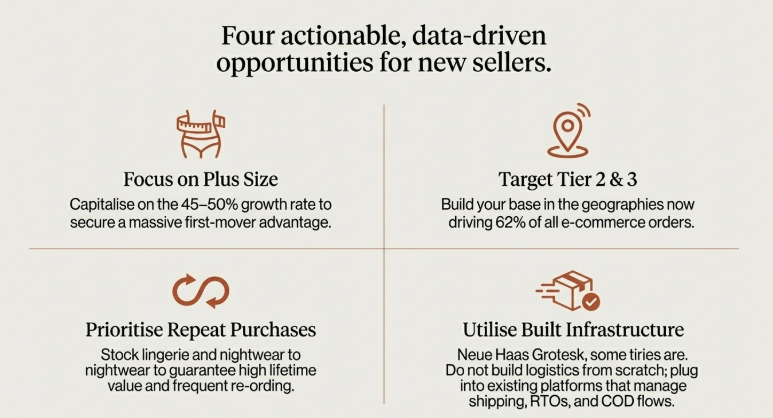
Opportunity 1 — Plus Size and Inclusive Fashion
The 45–50% annual growth in plus size fashion is the clearest market signal in Indian ecommerce today. This category is growing faster than any other fashion segment — and it is still massively underserved. Sellers who build a reputation in plus size fashion in their community have an extraordinary first-mover advantage.
Opportunity 2 — Tier 2 and Tier 3 Markets
As the geography data shows, Tier 2 and Tier 3 India now represents 62% of all fashion ecommerce orders — and is growing fastest. Sellers in these markets who establish community trust early are building businesses with structural advantages that metro sellers cannot replicate.
Opportunity 3 — Lingerie and Nightwear as Repeat-Purchase Categories
Unlike ethnic wear or occasion wear, lingerie and nightwear are consumed regularly — worn daily, replaced frequently, and gifted often. Sellers in these categories build loyal customer bases with high lifetime value. A customer who buys quality nightwear from you once typically comes back 4–6 times per year.
Opportunity 4 — The Infrastructure Is Already Built
The biggest barrier to scaling a fashion business used to be logistics. Today, that barrier is largely gone. Understanding how Snazzyway ships 1.5 lakh parcels every month across India shows exactly what world-class fashion logistics looks like — and how sellers can plug into it without building it themselves.
Section 5: Where Indian Fashion Ecommerce Is Headed — 2026 and Beyond
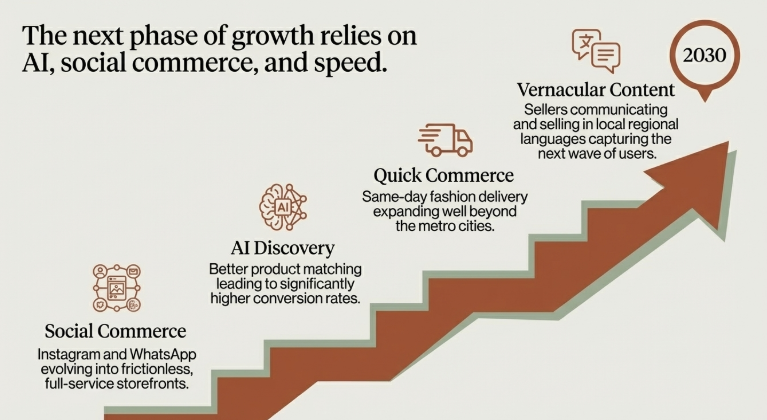
The growth story is far from over. Here is what the next phase looks like:
| Trend | What It Means for Sellers |
|---|---|
| AI-powered product discovery | Better product matching leads to higher conversion rates |
| Social commerce acceleration | Instagram and WhatsApp are becoming full storefronts |
| Quick commerce for fashion | Same-day delivery expanding beyond metro cities |
| Sustainable fashion demand rising | Eco-conscious buyers creating a premium segment |
| Live selling growth | Real-time product demos driving impulse purchases |
| Vernacular content advantage | Sellers communicating in local languages are winning |
The sellers who will lead Indian fashion ecommerce in 2030 are starting and building right now. The infrastructure, the market, and the tools have never been more accessible.
For women who are ready to take that step — whether they are just exploring the idea or ready to start today — our complete guide on 10 things every woman should know before starting an online fashion business is the most practical starting point available.
Conclusion: The 3X Growth Story Is Just the Beginning
Indian fashion ecommerce growing 3X faster than offline retail is not a temporary anomaly. It is a structural, permanent shift in how Indian women discover, buy, and sell fashion.
The turning points — affordable internet in 2016, the comfort revolution in 2020, the creator economy from 2022 — have each added a new layer to this transformation. And each layer has made the opportunity bigger, more accessible, and more democratised than before.
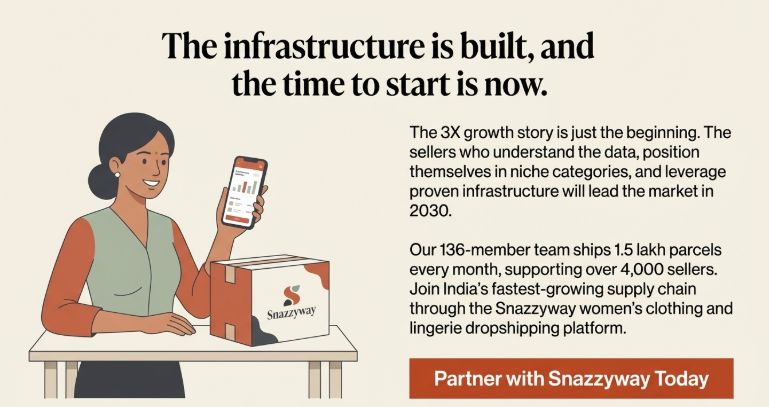
At Snazzyway, we have been part of this story since the very beginning. From 4 employees in 2014 to a 136-member team shipping 1.5 lakh parcels every month today — our growth is a direct reflection of the market we serve and the 4,000+ sellers we have had the privilege of supporting.
The opportunity in Indian fashion ecommerce is real, it is large, and it is far from over. The sellers who understand the data, position themselves in the right categories, and build on proven infrastructure will be the ones who look back in 5 years and realise they got in at exactly the right time.
Women and entrepreneurs who want to build a fashion business on India's fastest-growing supply chain can explore our women's clothing and lingerie dropshipping platform — built specifically to help sellers across all of India capitalise on exactly the opportunity this data describes.
❓ Frequently Asked Questions (FAQ)
Q1. How much faster is fashion ecommerce growing compared to offline retail in India? Fashion ecommerce in India is growing at 28–35% annually compared to 8–12% for offline fashion retail — making it approximately 3X faster. The gap has been widening consistently since 2016 and shows no signs of reversing.
Q2. What caused Indian fashion ecommerce to grow so fast after 2016? Three major turning points drove the acceleration: Jio's affordable internet launch in 2016 which brought hundreds of millions of new online shoppers, the 2020 pandemic which permanently shifted demand toward comfort fashion categories, and the creator economy from 2022 which made social selling accessible to every woman with a smartphone.
Q3. Which fashion categories are growing fastest in Indian ecommerce? Plus size fashion is growing fastest at 45–50% annually, followed by lingerie and innerwear at 38–42% and nightwear and loungewear at 35–40%. All three categories share a common factor — they are severely underserved in offline retail across most of India.
Q4. Why is Tier 2 India driving more fashion ecommerce growth than metro cities? Tier 2 and Tier 3 cities now represent 62% of all fashion ecommerce orders in India. These markets have lower competition, stronger community trust networks, rising smartphone penetration, and massive unmet demand for quality fashion — all factors that accelerate growth faster than already-saturated metro markets.
Q5. Is it still a good time to start a fashion ecommerce business in India? Yes — strongly. Despite the growth already seen, a large portion of India's fashion market is still offline and unconverted to ecommerce. Tier 2 and Tier 3 markets are still in early growth stages, plus size and comfort categories are still underserved, and the infrastructure to start a fashion business has never been more accessible or affordable.
Q6. How has Snazzyway's business grown alongside India's fashion ecommerce boom? Snazzyway started in 2014 with 4 employees and has grown to a 136-member team shipping over 1.5 lakh parcels every month across 28+ states. Active seller partnerships have grown to 4,000+ across India and globally — directly reflecting the ecommerce growth curve described in this article.
Q7. What is the biggest opportunity in Indian fashion ecommerce right now? Plus size fashion combined with Tier 2 and Tier 3 market penetration represents the single biggest untapped opportunity. A seller who builds a trusted brand in plus size lingerie or nightwear in a Tier 2 city today has an enormous first-mover advantage with very limited direct competition.
Q8. How can a new seller take advantage of India's fashion ecommerce growth? Start by choosing a high-growth niche — plus size, lingerie, or nightwear. Sell to your immediate community first through WhatsApp and Instagram. Partner with a reliable supplier who handles logistics and quality for you. Focus obsessively on customer experience to build repeat purchase rates. The infrastructure and the market are both on your side.
You must login to post a comment.

Related Articles
You may also like these posts
What 10,000+ Reviews Taught Us in 12 Years
Aug 09, 2026
Why We Rebuilt the Snazzyway Review System
Aug 09, 2026
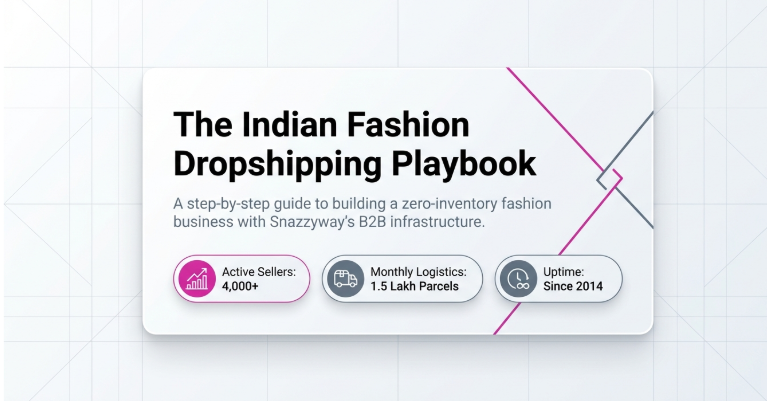
How Snazzyway Works — A Complete Guide for New Dropshipping Sellers in India
Mar 30, 2026
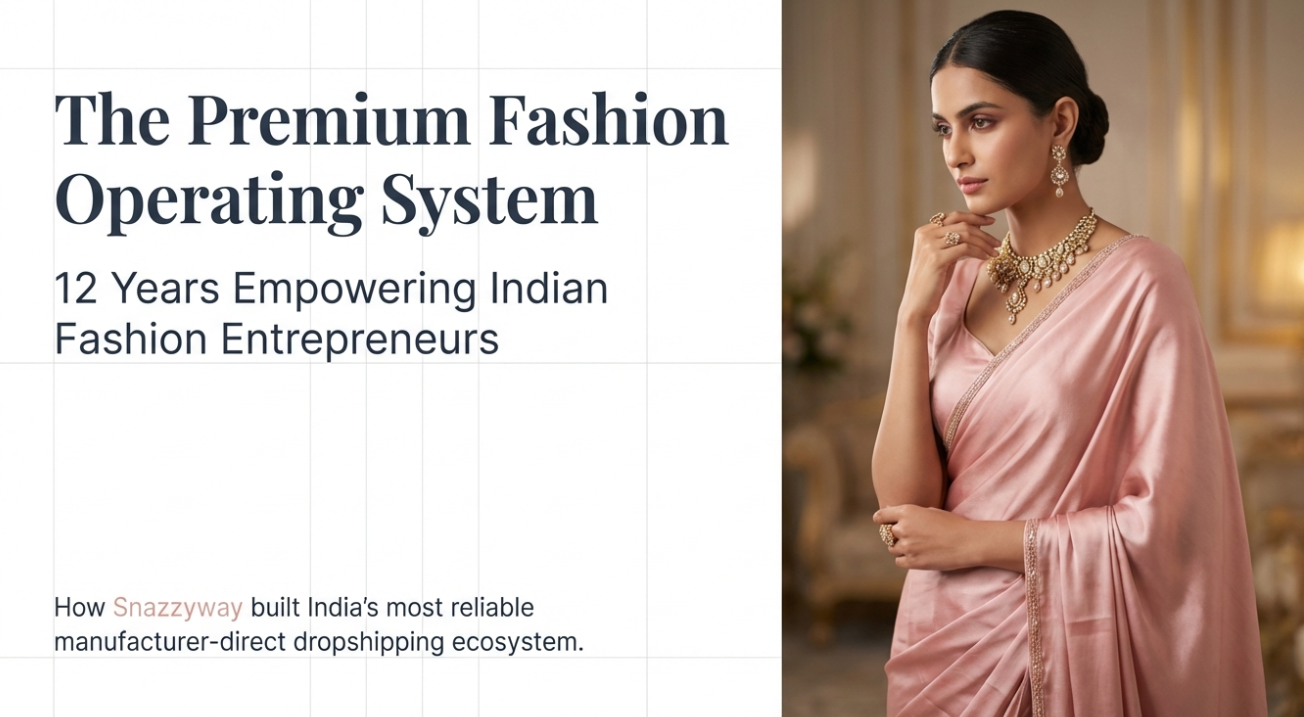
How Snazzyway Has Supported Indian Fashion Sellers for 12 Plus Years
Mar 30, 2026
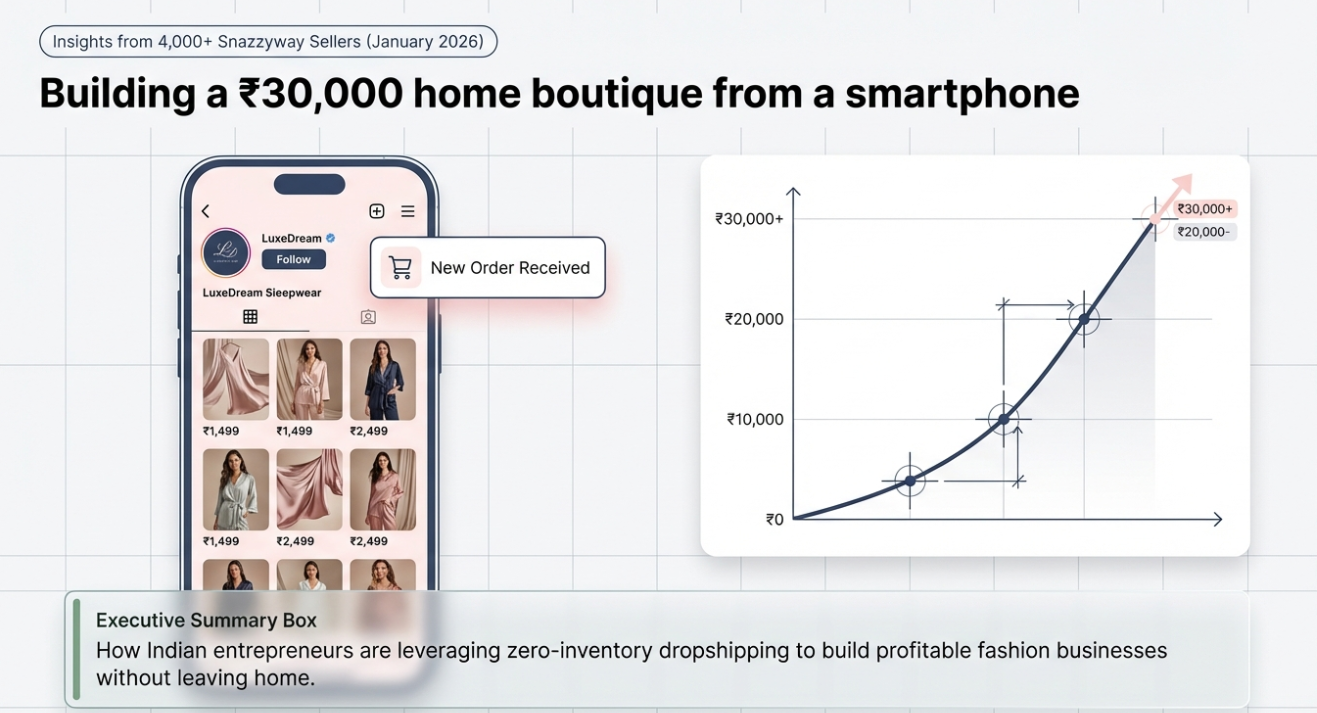
How Indian Housewives Are Earning ₹30,000 a Month Selling Online From Home
Mar 30, 2026