Why Women Fashion Is the Best Category to Sell Online in India Right Now
✍️ Snazzyway Editorial Team | ⏱️ 9 min read
Why is women's fashion the best category to sell online in India?
Women's fashion is the best category to sell online in India right now because it combines the three things every successful ecommerce business needs — massive and growing demand, high repeat purchase behaviour, and accessible entry points for new sellers. India's women's fashion ecommerce market is growing faster than almost every other product category online, driven by smartphone penetration, increasing female purchasing power, and a shift toward buying intimate and everyday clothing online for privacy and convenience.
📋 Quick Summary
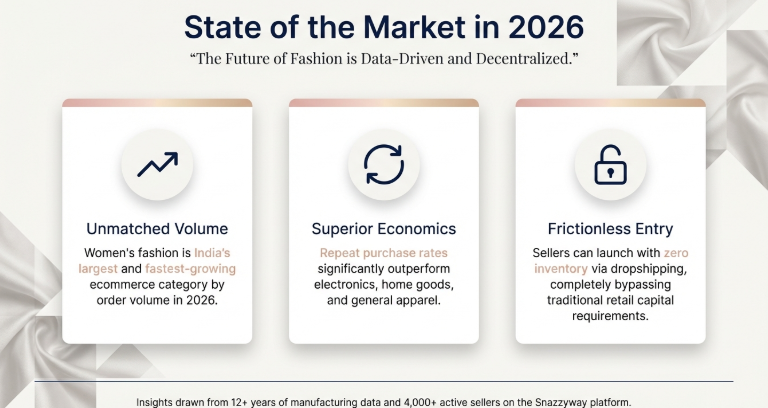
- Women's fashion is India's largest and fastest growing ecommerce category by order volume in 2026
- Repeat purchase rates in this category are significantly higher than electronics, home goods, or general apparel
- Subcategories like lingerie, nightwear, and plus-size fashion are growing faster than the overall category
- Entry barriers are low — sellers can start with zero inventory through dropshipping
- Snazzyway has worked with 4,000+ sellers in this category since 2014 and has seen consistent growth across all regions and city tiers
- This post covers market data, the best subcategories to start with, pros and cons, and a full FAQ
Introduction
If you are trying to decide which product category to build your online store around in India in 2026, the answer is not electronics. It is not home decor. It is not even general clothing.
It is women's fashion — and more specifically, the subcategories within women's fashion that most new sellers overlook because they seem too niche or too sensitive to sell online.
After 12+ years of manufacturing and supplying women's fashion products, and working directly with 4,000+ active online sellers across India, Europe, and the USA, we have watched this category grow from a niche online segment into one of the most reliable ecommerce businesses a seller in India can build. The data backs this up. The seller outcomes back this up. And the direction of consumer behaviour in India backs this up even more strongly as we move through 2026.
Here is why women's fashion is the single best category to sell online in India right now — and how to position yourself to take advantage of it.
The Market Numbers Tell the Story
India's ecommerce market is one of the fastest growing in the world. But within that market, women's fashion consistently outperforms every other major category on the metrics that matter most to sellers — order frequency, basket size, and repeat purchase rate.
Fashion ecommerce in India has grown 3x faster than offline retail over the past several years — and 2026 is showing no signs of that trend slowing down. This is not a temporary spike. It is a structural shift in how Indian women shop, one that is accelerating as smartphone penetration deepens into tier 2 and tier 3 cities and UPI makes digital payments frictionless even for first-time online buyers.
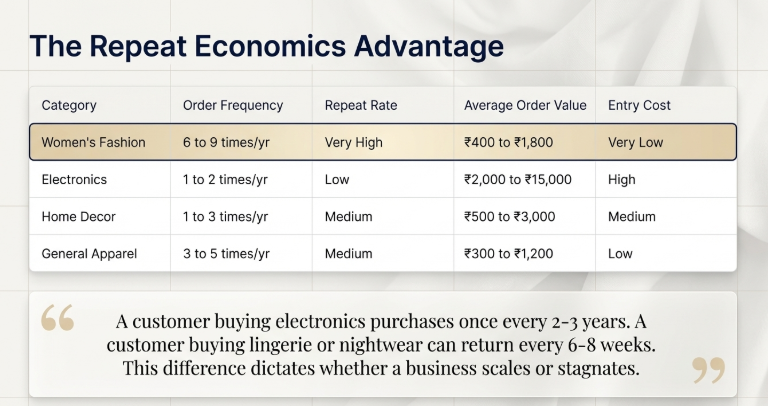
| Metric | Women's Fashion | Electronics | Home Decor | General Apparel |
|---|---|---|---|---|
| Average order frequency per customer per year | 6 to 9 times | 1 to 2 times | 1 to 3 times | 3 to 5 times |
| Repeat purchase rate | Very High | Low | Medium | Medium |
| Average order value | ₹400 to ₹1,800 | ₹2,000 to ₹15,000 | ₹500 to ₹3,000 | ₹300 to ₹1,200 |
| Return rate (lingerie subcategory) | Low to Very Low | Medium | Low | Medium |
| Entry cost for new sellers | Very Low | High | Medium | Low |
The repeat purchase rate column is the most important number in that table. A customer who buys a phone from you buys once every two to three years. A customer who buys lingerie or nightwear from you can buy every 6 to 8 weeks. That difference is what separates a business that grows from one that stagnates.
Why Women's Fashion Specifically — Not Just Fashion in General
General apparel is competitive. Sarees, kurtas, men's shirts — these categories are dominated by large players with deep catalogue depth and aggressive pricing. A new seller entering general apparel in 2026 is fighting on price from day one, against established brands and marketplace giants with years of review history.
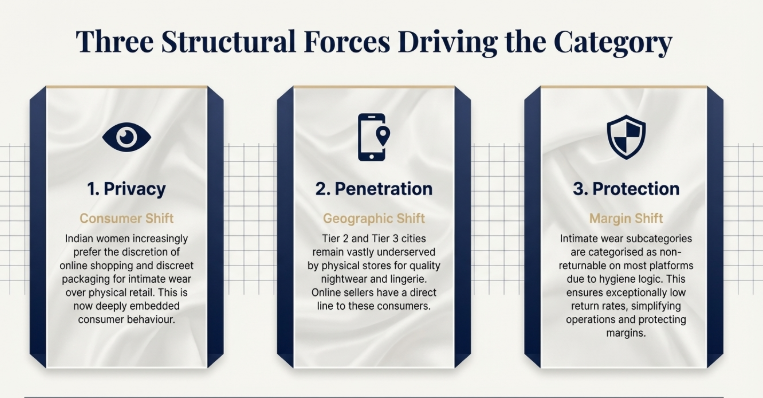
Women's fashion — and specifically intimate wear, nightwear, and plus-size fashion — is different for three specific reasons.
Reason 1 — Privacy drives online preference. Indian women increasingly prefer to buy intimate clothing online rather than in a physical store. The privacy of online shopping, combined with discreet packaging, means that a category that was historically retail-only has shifted significantly online. This preference is now deeply embedded consumer behaviour, not a trend that will reverse.
Reason 2 — Tier 2 and tier 3 cities are still underserved. A woman in a small city in Rajasthan, Uttar Pradesh, or Madhya Pradesh may have very limited access to quality lingerie and nightwear in physical stores near her. Online sellers can reach her directly. Even in 2026, this is a market that large fashion retailers have not fully captured — and where independent online sellers have a real structural advantage.
Reason 3 — The category is non-returnable in many cases. Lingerie and intimate wear are categorised as non-returnable on most Indian marketplaces and are rarely returned even on independent stores, because customers understand the hygiene logic. For sellers, a low return rate means better margins, simpler operations, and healthier reviews over time.
🔍 Snazzyway Insight
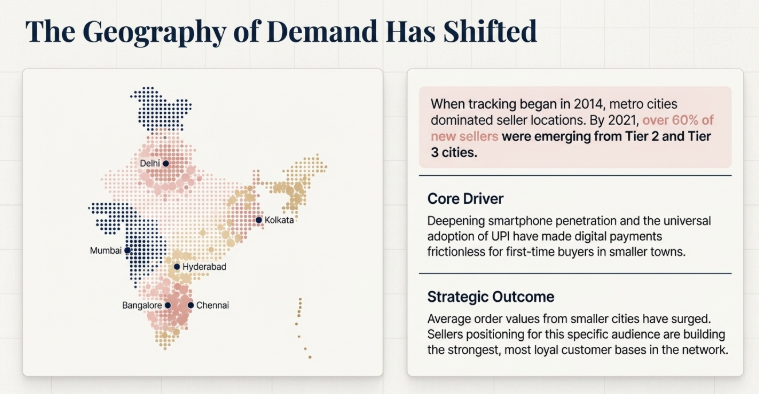
When we started working with online sellers in 2014, most of our early seller partners were based in metro cities — Mumbai, Delhi, Bengaluru. By 2021, more than 60% of new sellers joining our platform were from tier 2 and tier 3 cities. By 2026, that number has grown further still — and the average order values from smaller cities have increased significantly as consumer purchasing power in those markets has risen.
The demand was always there in smaller cities. What changed was smartphone penetration, UPI payments, and the confidence of buyers in smaller towns to purchase intimate wear online. Sellers who positioned themselves for this audience early built some of the strongest and most loyal customer bases in our entire network.
You can read the detailed breakdown of what this shift looked like across 4,000 seller accounts in what 4,000 sellers taught us about success in the women's clothing business in India.
The Best Subcategories Within Women's Fashion to Start With in 2026
Not all subcategories within women's fashion perform equally from a seller's perspective. Here is an honest breakdown of the best entry points based on real performance data from our seller network going into 2026.
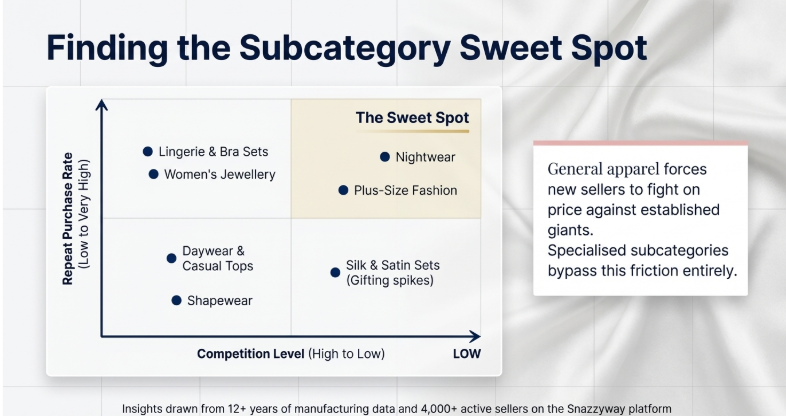
| Subcategory | Demand Level | Competition | Repeat Purchase | Best For |
|---|---|---|---|---|
| Lingerie and bra sets | Very High | Medium | Very High | Sellers wanting consistent daily orders |
| Nightwear | Very High | Low to Medium | High | Easy entry, high satisfaction, low returns |
| Plus-size fashion | High and growing fast | Low | High | Underserved market with exceptionally loyal buyers |
| Shapewear | High | Medium | Medium to High | High AOV, premium positioning |
| Silk and satin sets | Medium | Low | Medium | Gifting season revenue spikes |
| Daywear and casual tops | High | High | Medium | Broader audience but significantly more competition |
| Women's jewellery | Medium | Medium | High | Strong add-on category for bundling and AOV increase |
For new sellers starting in 2026, nightwear remains the easiest subcategory to enter — high demand, straightforward sizing, low return rates, and a customer base that buys repeatedly throughout the year rather than only during gifting seasons.
Bra sets deliver the highest repeat purchase frequency of any subcategory we track. Once a customer finds a bra set she likes — the right fit, the right fabric, the right price — she comes back for it again and again. Building a store around this category means building a business with genuinely recurring revenue.
Plus-size fashion deserves special mention in 2026. This is still the most underserved segment in Indian women's fashion ecommerce. Most mainstream stores carry limited plus-size options, and the options that exist are often designed poorly. Sellers who invest in quality plus-size catalogue depth build extremely loyal customer bases with very low churn — and in 2026, this audience is larger, more connected, and more willing to spend than ever before.
Pros and Cons of Selling Women's Fashion Online in India in 2026
Pros
- Massive and still-growing market with demand across all price points from ₹299 to ₹2,000+
- High repeat purchase rate — customers come back without you spending more on ads every time
- Low entry cost — dropshipping model means zero inventory investment to start in 2026
- Non-returnable subcategories like lingerie protect margins and simplify operations significantly
- Tier 2 and tier 3 city demand is growing faster than metro demand — less competition, more opportunity
- Strong gifting seasons — Valentine's Day, Diwali, wedding season — create predictable and plannable revenue spikes
- Social media sells this category extremely well — Instagram and Facebook conversion rates remain high in 2026
Cons
- Sizing is complex — poor size guides still lead to customer dissatisfaction even with quality products
- Trust building takes time — new stores in 2026 need reviews and social proof before conversion rates improve meaningfully
- Photography matters enormously — bad photos kill sales regardless of how good the product actually is
- Requires a reliable supplier — the category's strength becomes a weakness if your supplier is inconsistent
- Seasonal demand fluctuations require catalogue management — what sells in summer does not always sell in winter
The cons in this list are all manageable. They are execution challenges, not structural problems with the category itself. The pros are structural — built into the nature of the product and the deeply embedded behaviour of Indian consumers in 2026.
Personal Experience — What 12 Years in This Category Has Taught Us
We started Snazzyway in 2014 with a straightforward belief — that Indian women deserved access to quality intimate wear at fair prices, and that the internet was the right channel to deliver it.
What we did not fully anticipate was how quickly the market would grow, how deep the demand would run in smaller cities, and how loyal customers in this category would be once they found a store they trusted.
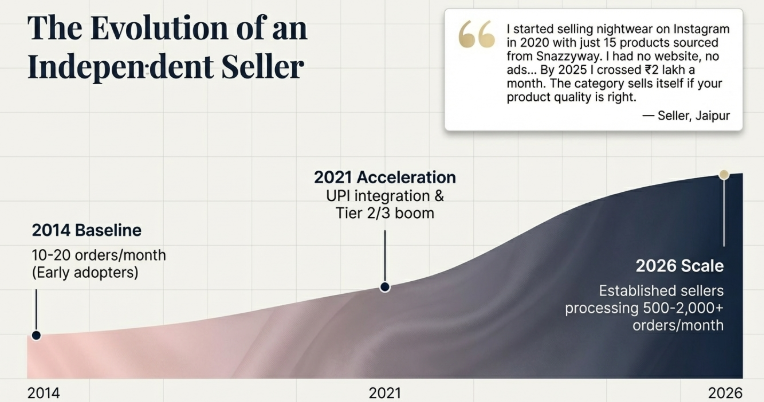
In our early years, our average seller was processing 10 to 20 orders per month. Today in 2026, established sellers on our platform regularly process 500 to 2,000 orders per month. The category did not change. What changed was the infrastructure around it — better logistics networks, UPI payments becoming universal, increasing consumer comfort with online shopping — and the sellers who positioned themselves early to ride that wave are now running genuinely profitable businesses.
The sellers who struggled were almost always the ones who treated this as a quick money opportunity — sourcing cheap products, ignoring quality, skipping size guides, using bad photos. The sellers who built real businesses were the ones who treated their online store like a brand from day one, even when they were only processing 20 orders a month.
📍 From Our Seller Network "I started selling nightwear on Instagram in 2020 with just 15 products sourced from Snazzyway. I had no website, no ads — just organic posts and WhatsApp orders. By 2022 I had moved to Shopify and was doing ₹80,000 a month. By 2025 I crossed ₹2 lakh a month. The category sells itself if your product quality is right." — Seller, Jaipur
How to Position Your Store for Maximum Advantage in 2026
Knowing the category is strong is only half the answer. Here is how to position your store to capture the maximum advantage from it specifically in 2026.
Start narrow, go deep. Do not try to sell everything in women's fashion from day one. Pick one subcategory — nightwear, bra sets, or plus-size — and build a catalogue of 30 to 50 products in that area before expanding. Customers and search engines both reward specialisation, and in 2026 the search algorithms reward topical depth more than ever.
Build for repeat purchases from the start. Collect customer WhatsApp numbers or emails from your very first order. Send a follow-up message after delivery asking for feedback. Create a reason for customers to come back — a loyalty discount, early access to new arrivals, a referral incentive. The economics of this category only fully work when you are converting first-time buyers into repeat buyers.
Invest in your store's design and brand identity early. Studying top Shopify fashion stores in India for design and branding inspiration gives you a clear benchmark for what a professional, conversion-optimised women's fashion store looks like in 2026 — and how far most generic dropshipping stores fall short of that standard.
Choose your supplier before you choose your products. The supplier decision is more important than the product decision in this category. A great supplier with average products outperforms a poor supplier with great products every single time — because consistency, packaging quality, and shipping speed are what determine whether your first-time buyer comes back for a second purchase.
If you are in the process of setting up your store and evaluating supplier options in 2026, the guide on how to connect your Shopify store with an Indian fashion supplier walks through exactly what to look for and how to evaluate a supplier before committing.
🔍 Snazzyway Insight
One pattern we see consistently across our seller network in 2026 is that sellers who pick one subcategory and master it before expanding are significantly more profitable than sellers who launch with a broad catalogue immediately. A store that sells only nightwear and becomes the trusted destination for that specific customer need will outperform a general fashion store every time — both in search rankings and in customer loyalty.
Depth beats breadth in this category. In 2026, with increasing competition across Indian ecommerce, this principle matters more than ever.
Selling on Multiple Channels in 2026 — Where Women's Fashion Works Best
You are not limited to a single selling channel in 2026. Here is how women's fashion performs across the major channels available to Indian sellers right now.
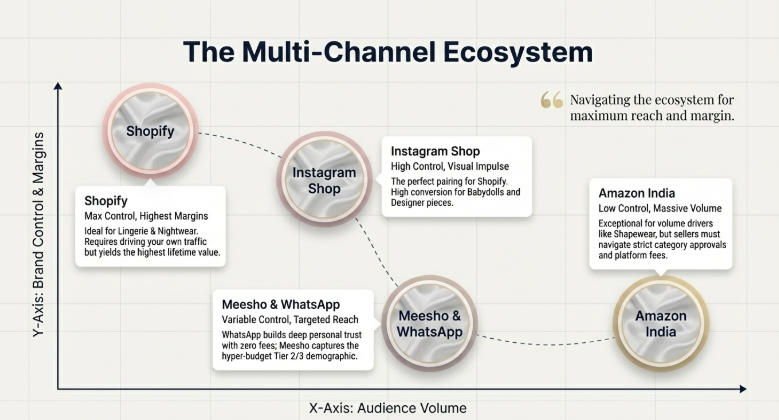
| Channel | Strengths | Best Subcategories | Competition Level |
|---|---|---|---|
| Shopify store | Full brand control, best margins | Lingerie, nightwear, gifting sets | Low — your own traffic |
| Amazon India | High trust, massive traffic | Shapewear, bra sets, nightwear | Medium to High |
| Instagram Shop | Visual category, impulse purchase | Babydolls, satin sets, designer pieces | Medium |
| Meesho | Tier 2 and tier 3 reach | Budget nightwear, basic innerwear | High |
| WhatsApp Commerce | Personal trust, zero platform fees | All subcategories, especially gifting | Low |
For sellers serious about building a brand with real margins in 2026, Shopify combined with Instagram remains the most powerful combination. Amazon India works exceptionally well for sellers who want volume and are comfortable with the platform's fee structure. If you are considering Amazon as a channel, the complete guide on how to sell lingerie on Amazon India in 2026 covers listing strategy, category approval, and margin management specific to this category.
Why a Manufacturer-Direct Supplier Is More Important Than Ever in 2026
The single most important operational decision in this category is your supplier choice. And the most important distinction to understand in 2026 is the difference between a manufacturer-direct supplier and a middleman or aggregator.
A middleman supplier buys from manufacturers and resells to you. This means an extra margin layer, less quality control, slower response to stock issues, and no ability to customise or scale with you as your business grows.
A manufacturer-direct supplier like Snazzyway controls its own production from start to finish — design, manufacturing, quality control, packaging, and fulfillment all happen under one roof at our unit in Haldwani, Uttarakhand. This means consistent product quality, stable pricing, faster dispatch, and the ability to offer white-label and private label options as you scale in 2026 and beyond.
For sellers who want to understand what this operational model looks like in practice before committing, read about the platform supporting thousands of fashion resellers — it covers how our seller infrastructure works from product sourcing through to customer delivery.
And if you are ready to start or scale a women's fashion store in 2026 with a supplier foundation that actually supports long-term growth, explore Snazzyway's dropshipping platform — India's leading women's clothing and lingerie dropshipping supplier since 2014, with 12,700+ products across 54 categories, trusted by 4,000+ active sellers across India, Europe, and the USA.
Frequently Asked Questions
Q1. Is women's fashion a good niche for dropshipping in India in 2026? Yes — it remains one of the highest performing dropshipping niches in India in 2026. The combination of high repeat purchase rates, low return rates in lingerie subcategories, and growing demand from tier 2 and tier 3 cities makes it one of the most reliable categories for building a sustainable online business. The key is choosing the right subcategory to start with and sourcing from a manufacturer-direct supplier.
Q2. Which women's fashion subcategory is easiest to start selling online in India in 2026? Nightwear is the easiest entry point for new sellers in 2026. Demand is high and consistent year-round, sizing is more straightforward than bras or shapewear, return rates are low, and customers in this subcategory are highly likely to repeat purchase once they find a store they trust. Bra sets deliver the highest repeat purchase frequency but require more attention to sizing guidance from the start.
Q3. How much investment do I need to start selling women's fashion online in India in 2026? With a dropshipping model, you can start with as little as ₹5,000 to ₹10,000 — primarily covering your Shopify subscription, a domain name, and initial marketing spend. You do not need to buy any inventory upfront. The supplier holds the stock and ships directly to your customers when orders come in.
Q4. Why do women prefer buying intimate wear online rather than in stores in India? Privacy is the primary reason. Buying intimate wear in a physical store requires interacting with salespeople and potentially other customers in what many women find an uncomfortable setting. Online shopping removes this entirely — customers can browse, compare, and purchase from home with discreet delivery to their door. This privacy preference is particularly strong in smaller cities and towns where social visibility in stores is higher.
Q5. What is the average profit margin when selling women's fashion online in India in 2026? Margins vary by subcategory and sourcing model. Sellers sourcing directly from a manufacturer like Snazzyway typically achieve margins of 35% to 55% on lingerie and nightwear products in 2026. Margins are higher on premium subcategories like silk satin sets and designer lingerie, and slightly lower on high-volume budget categories. The dropshipping model preserves these margins because there is no inventory holding cost or dead stock risk.
Q6. How do I handle sizing complaints when selling lingerie and intimate wear online? The most effective prevention is a detailed, product-specific size guide on every product page — with measurements in both centimetres and inches, a how-to-measure guide, and notes on whether specific products run small or large. Sellers who invest in clear size guidance before launching consistently report 40 to 60% fewer sizing complaints compared to stores with generic or missing size information.
Q7. Can I build a private label women's fashion brand through dropshipping in 2026? Yes. Several suppliers including Snazzyway offer white-label and private label options where products are shipped under your brand name with your custom tags and packaging. This allows you to build brand equity and customer loyalty from your very first order, without needing to manage your own manufacturing or inventory. As your order volume grows in 2026, private label options become increasingly accessible and cost-effective.
You must login to post a comment.

Related Articles
You may also like these posts
What 10,000+ Reviews Taught Us in 12 Years
Aug 09, 2026
Why We Rebuilt the Snazzyway Review System
Aug 09, 2026
How Snazzyway Works — A Complete Guide for New Dropshipping Sellers in India
Mar 30, 2026
How Snazzyway Has Supported Indian Fashion Sellers for 12 Plus Years
Mar 30, 2026
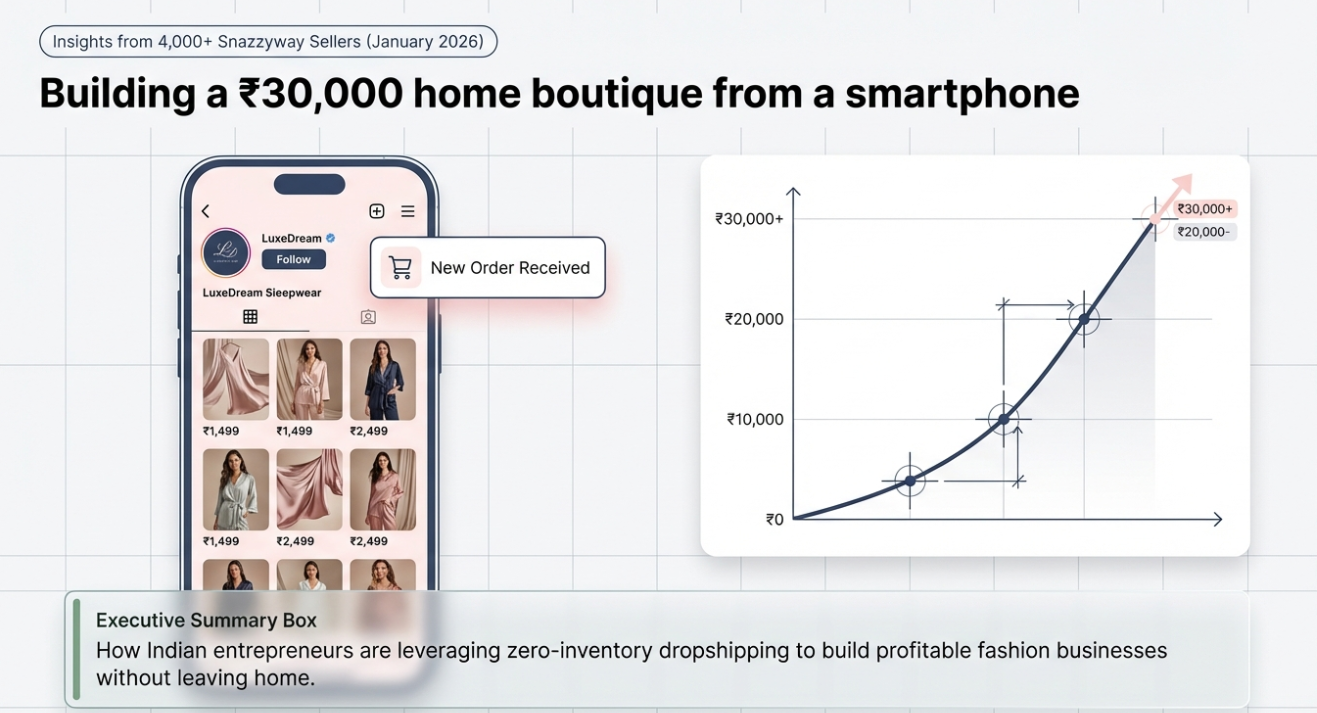
How Indian Housewives Are Earning ₹30,000 a Month Selling Online From Home
Mar 30, 2026