Snazzyway Explains: COD vs Prepaid – How Indian Women Prefer to Shop Fashion Online
Published by Snazzyway.com | India's Leading Women's Clothing & Lingerie Brand Since 2014 💳 Fashion & Ecommerce | ⏱ 8 min read
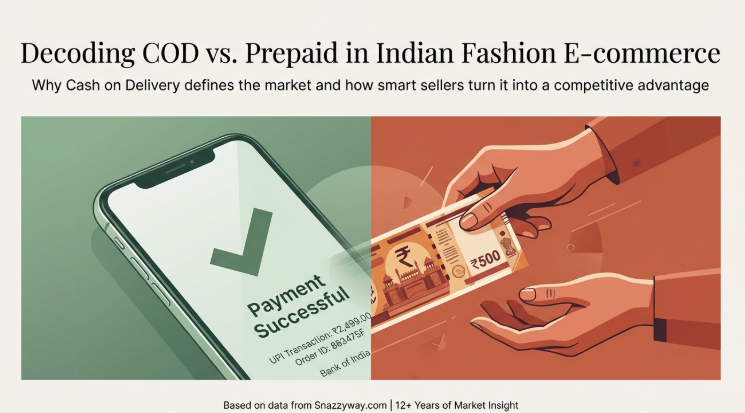
🔖 Quick Summary
- What is COD and Prepaid — explained simply
- Why Indian women still prefer COD for fashion shopping
- How COD impacts fashion brands and sellers
- Snazzyway's real data on COD vs Prepaid orders
- Honest Pros & Cons of both payment methods
- Snazzyway Insight: 12+ years of experience managing COD at scale
- How smart sellers are turning COD into a competitive advantage
- Frequently asked questions answered
Introduction: The Payment Method That Defines Indian Fashion Ecommerce
Walk into any ecommerce discussion in India and one topic always comes up — COD.
Cash on Delivery is not just a payment option in India. It is a cultural preference, a trust mechanism, and for millions of women shopping fashion online for the first time — it is the only way they feel safe buying.
At Snazzyway, we have been shipping women's lingerie, nightwear, and fashion across India since 2014. In 12+ years of serving over 4,000 sellers and hundreds of thousands of direct customers, we have seen exactly how Indian women pay — and more importantly, why they pay the way they do.
In this article, we break down the COD vs Prepaid debate honestly — with real data, real seller insights, and practical advice for anyone building a fashion business in India.
What Is COD and What Is Prepaid — Simply Explained
Before we dive into data and strategy, let us make sure both terms are crystal clear.
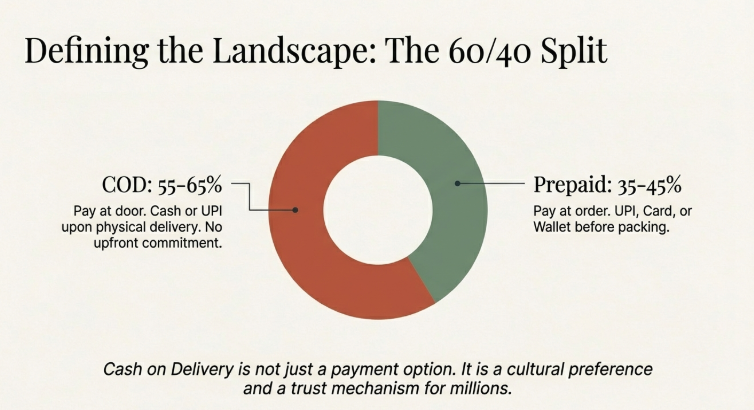
COD (Cash on Delivery) means the customer pays only when the parcel arrives at their door. They order online but hand over cash — or sometimes do a UPI scan — at the time of delivery. No upfront payment required.
Prepaid means the customer pays at the time of placing the order — via UPI, debit card, credit card, net banking, or wallet. The money is collected before the parcel is even packed.
Simple enough. But the implications for fashion sellers are enormous — and that is exactly what this article is about.
Snazzyway by the Numbers – COD vs Prepaid Reality in India
| Metric | COD (Cash on Delivery) | Prepaid |
|---|---|---|
| Share of Fashion Orders in India | 55–65% | 35–45% |
| Average RTO Rate | 20–35% | 2–5% |
| Customer Trust Level (Tier 2/3) | Very High | Medium |
| Order Cancellation Rate | Higher | Lower |
| Working Capital Impact | Delayed remittance | Instant payment |
| Preferred by First-Time Buyers | Yes | Rarely |
| Preferred by Repeat Buyers | Sometimes | Yes |
| Snazzyway’s Managed RTO | 3–7% | Under 2% |
Section 1: Why Indian Women Still Choose COD for Fashion
This is the question every fashion brand asks — it is 2026, UPI is everywhere, so why is COD still so dominant?
The answer is not simple. It is a combination of trust, habit, and very valid past experiences.
1. They Have Been Burned Before
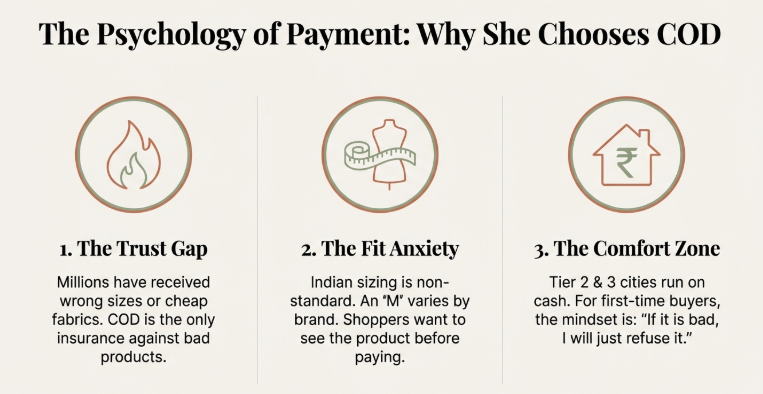
Millions of Indian women have ordered fashion online and received something completely different — wrong size, wrong color, cheap fabric, or a product that looked nothing like the photo. When that happens with a prepaid order, getting a refund is a nightmare. COD protects them from that risk completely.
2. Sizing Is Still Unpredictable
India does not have a standardized sizing system. An M from one brand fits like an S from another. For lingerie especially — where fit is everything — women prefer to see the product first before paying. COD gives them that safety net.
3. Tier 2 and Tier 3 India Runs on Cash
A large portion of Snazzyway's orders come from smaller cities and towns where digital payment habits are still developing. For these customers, COD is not just a preference — it is the most comfortable option available.
4. First-Time Buyers Need Trust
When a woman buys from a new brand for the first time, COD dramatically reduces the psychological barrier. She thinks — "if it is bad, I will just refuse it." That confidence drives her to place the order at all.
Section 2: Why Prepaid Is Growing Fast in India
Despite COD's dominance, prepaid is growing rapidly — especially among urban, repeat buyers.
1. UPI Made It Effortless
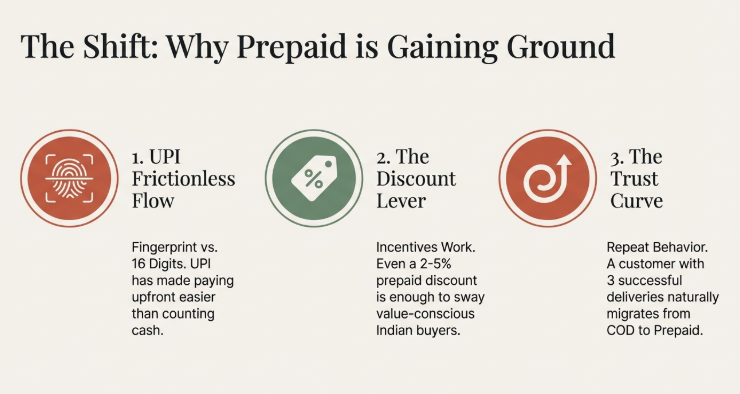
Before UPI, paying online meant entering 16-digit card numbers and OTPs. Today, it is a 4-digit PIN or a fingerprint. That simplicity has converted millions of COD buyers into prepaid buyers.
2. Prepaid Discounts Work
Brands that offer even a 2–5% discount on prepaid orders see significant shifts in payment preference. Indian buyers are value-conscious — a small saving is enough motivation to pay upfront.
3. Repeat Buyers Trust the Brand
A customer who has received 3 good orders from Snazzyway does not need the COD safety net anymore. Brand trust converts COD buyers into prepaid buyers naturally over time.
4. Faster Delivery on Prepaid
Many logistics partners prioritize prepaid shipments for faster delivery. Buyers who understand this choose prepaid for speed.
📊 COD vs Prepaid – State-Wise Preference in India
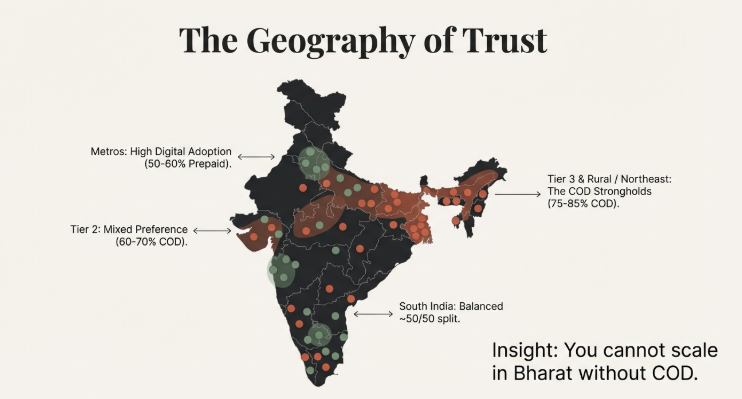
| Region | COD Preference | Prepaid Preference | Notes |
|---|---|---|---|
| Metro Cities (Delhi, Mumbai, Bangalore) | 40–50% | 50–60% | High digital adoption |
| Tier 2 Cities (Lucknow, Surat, Indore) | 60–70% | 30–40% | Mixed preference |
| Tier 3 & Rural India | 75–85% | 15–25% | COD dominant |
| Northeast India | 70–80% | 20–30% | COD strongly preferred |
| South India (Tamil Nadu, Kerala) | 45–55% | 45–55% | Most balanced |
✅ Pros & Cons – COD vs Prepaid for Fashion Sellers
| Payment Mode | Pros | Cons |
|---|---|---|
| ✅ COD (Cash on Delivery) | • Higher order volume• Reaches first-time buyers• Works well in Tier 2/3 India• Builds brand reach fast | • High RTO risk• Delayed cash remittance• Double shipping cost on returns• Fraud risk at delivery |
| ✅ Prepaid | • Zero RTO risk• Instant cash flow• Lower logistics cost• No remittance delay | • Lower order volume• Misses first-time buyers• Needs brand trust first• Harder to scale in Tier 3 |
💡 Snazzyway Insight: What 12 Years of COD Data Taught Us
"When we started in 2014, almost 80% of our orders were COD. We had no choice — that was simply how India shopped. But managing COD at scale taught us things no business school ever could."
Here is what 12+ years and 4,000+ seller partnerships across India have taught the Snazzyway team about COD:
COD is not your enemy — unmanaged COD is.
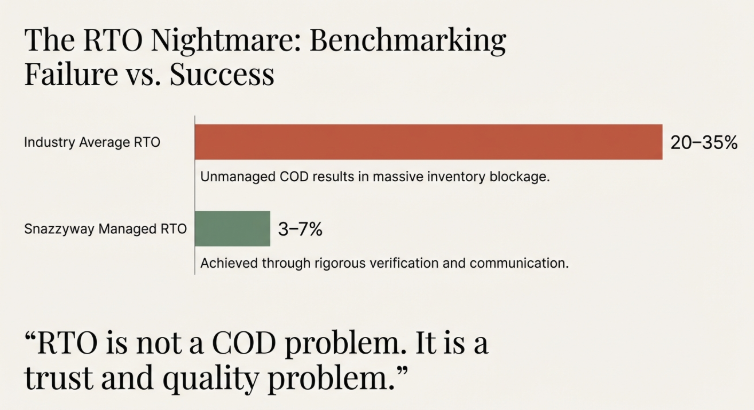
Most fashion brands fear COD because of high RTO. But RTO is not a COD problem — it is a trust and quality problem. When customers receive exactly what they expected — right size, right product, right quality — they pay at the door without hesitation.
At Snazzyway, we brought our COD RTO down to 3–7% — compared to the industry average of 20–30% — by doing three things consistently:
- Accurate product photography that shows real fit and fabric
- Detailed size charts that actually match the product
- Post-order communication that reminds customers their parcel is coming
The third point is underrated. A customer who receives a WhatsApp message saying "Your Snazzyway order is out for delivery today" is mentally prepared to receive and pay. That simple message reduces refusals dramatically.
Our advice to every seller: Do not disable COD to reduce RTO. Fix the reasons customers refuse — and COD becomes your biggest growth engine in India.
— The Snazzyway Team, Delhi (Since 2014)
Section 3: How COD Impacts Fashion Sellers — The Real Math
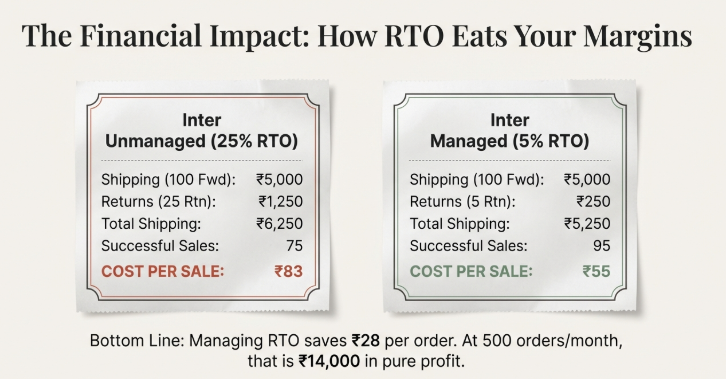
Let us look at what COD actually costs a fashion seller — because understanding the math is what separates profitable sellers from struggling ones.
Scenario: 100 COD Orders
| Item | Numbers |
|---|---|
| Total Orders | 100 |
| Successful Deliveries (75%) | 75 |
| RTO Orders (25%) | 25 |
| Forward Shipping Cost (100 orders) | ₹5,000 (₹50 per order) |
| Return Shipping Cost (25 orders) | ₹1,250 (₹50 per order) |
| Total Shipping Cost | ₹6,250 |
| Effective Shipping Cost per Sale | ₹83 per successful order |
Now compare this with a seller using Snazzyway's managed fulfillment model where RTO is just 5%:
| Item | Numbers |
|---|---|
| Total Orders | 100 |
| Successful Deliveries (95%) | 95 |
| RTO Orders (5%) | 5 |
| Forward Shipping Cost | ₹5,000 |
| Return Shipping Cost | ₹250 |
| Total Shipping Cost | ₹5,250 |
| Effective Shipping Cost per Sale | ₹55 per successful order |
The difference is ₹28 per order. At 500 orders a month that is ₹14,000 saved every month — just by managing RTO better.
This is exactly why sellers who partner with structured fashion fulfillment and dropshipping infrastructure in India consistently outperform those managing logistics on their own.
Section 4: How Smart Sellers Are Using COD as a Growth Strategy
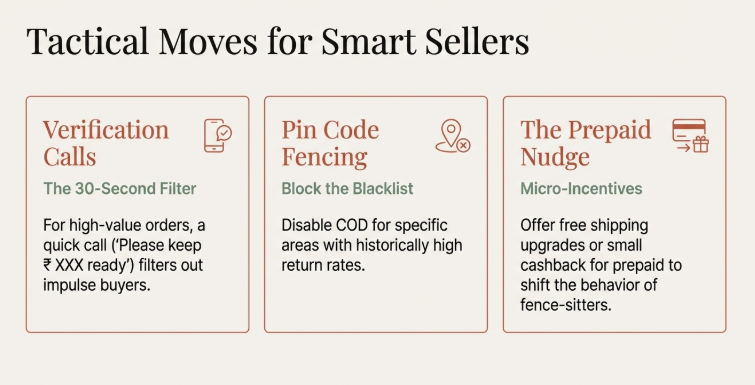
The best fashion sellers in India do not avoid COD — they use it strategically.
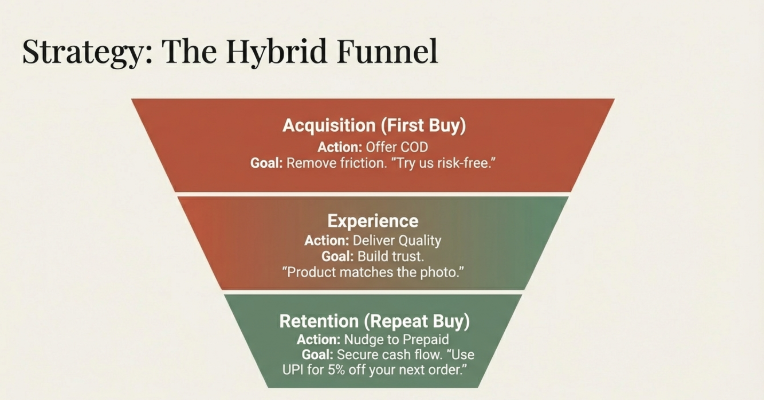
Strategy 1 — COD to Acquire, Prepaid to Retain
Offer COD to first-time buyers to reduce purchase hesitation. Once they receive a good experience, nudge them toward prepaid on their next order with a small discount. This is how you build a loyal prepaid customer base starting from COD.
Strategy 2 — COD Verification Calls
For high-value orders or high-risk pin codes, a quick verification call or WhatsApp message before dispatch dramatically reduces fake orders and refusals. A 30-second message — "Hi, your order is being packed, please keep ₹XXX ready" — filters out genuine buyers from impulse orderers.
Strategy 3 — Prepaid Incentives
Even a 2% cashback or free shipping upgrade for prepaid orders shifts a meaningful percentage of buyers toward upfront payment. This improves cash flow without reducing order volume.
Strategy 4 — Smart Pin Code Management
Not all pin codes are equal. Some areas have historically high COD refusal rates. Smart sellers either disable COD for those pin codes or add a small COD handling fee to make fulfillment financially viable.
Section 5: What This Means for Women Shopping Fashion Online
If you are a customer reading this — here is what you should know:
COD is completely fine to use. Reputable brands like Snazzyway support COD across all 28+ states because they understand Indian shoppers. You never need to feel pressured into paying upfront for a brand you are trying for the first time.
Prepaid has real advantages too. Once you trust a brand, switching to prepaid often means faster delivery, better customer priority, and sometimes exclusive discounts.
The best approach: Try COD the first time. If the brand delivers well — and Snazzyway always does — switch to prepaid and enjoy the benefits of being a verified, trusted customer.
Section 6: The Future of COD in Indian Fashion Ecommerce
COD is not disappearing — but it is evolving. Here is what the next few years look like:
UPI-on-delivery is replacing pure cash COD in many cities. Customers scan a QR code at the door instead of handling cash. This reduces fraud, speeds up remittance, and keeps the "pay at door" comfort intact.
Buy Now Pay Later (BNPL) options are also growing — giving customers the feel of COD with the cash flow benefits of prepaid for sellers.
For fashion brands, the future is a smart hybrid model — COD for acquisition in new markets, prepaid for retention in established ones. Brands and sellers that master this balance will dominate Indian fashion ecommerce in the next decade.
Entrepreneurs who want to build this kind of smart, scalable fashion business can explore how India's leading women's clothing dropshipping platform is already helping 4,000+ sellers manage COD and prepaid at scale — without the operational headaches.
Conclusion: COD or Prepaid — The Answer Is Both
After 12+ years and millions of orders across India, Snazzyway's honest answer to the COD vs Prepaid debate is this — you need both, and you need to manage both well.
COD gives you reach. Prepaid gives you cash flow. Together, managed intelligently, they give you a fashion business that scales across every corner of India — from South Delhi to small-town Assam.
The brands winning in Indian fashion ecommerce today are not the ones who chose one over the other. They are the ones who built systems smart enough to handle both — and kept their customers happy either way.
You must login to post a comment.

FAQs
Find answers to the most common questions below.
Related Articles
You may also like these posts
What 10,000+ Reviews Taught Us in 12 Years
Aug 09, 2026
Why We Rebuilt the Snazzyway Review System
Aug 09, 2026
How Snazzyway Works — A Complete Guide for New Dropshipping Sellers in India
Mar 30, 2026
How Snazzyway Has Supported Indian Fashion Sellers for 12 Plus Years
Mar 30, 2026
How Indian Housewives Are Earning ₹30,000 a Month Selling Online From Home
Mar 30, 2026