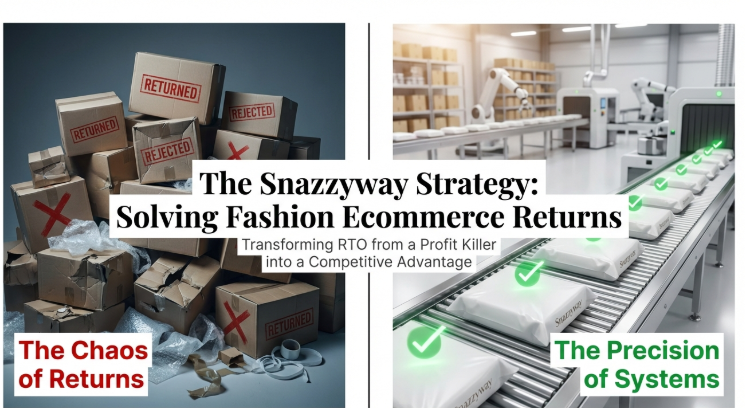
Snazzyway on Returns – Why High RTO Is Killing Fashion Brands & How to Avoid It
Published by Snazzyway.com | India's Leading Women's Clothing & Lingerie Brand Since 2014 📦 Fashion & Ecommerce | ⏱ 8 min read
🔖 Quick Summary
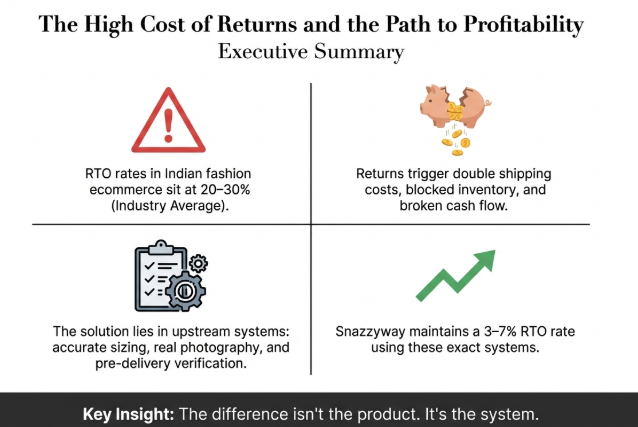
- What RTO is and why it is destroying fashion businesses in India
- The real cost of high RTO — numbers every seller must know
- Top reasons why fashion parcels come back unsold
- How Snazzyway maintains a 3–7% RTO rate vs industry average of 20–30%
- Honest Pros & Cons of COD in the context of RTO
- Snazzyway Insight: 12+ years of managing returns at scale
- Practical steps every fashion brand can take to reduce RTO today
- Frequently asked questions answered
Introduction: The Silent Profit Killer Nobody Talks About Enough
Ask any fashion seller in India what their biggest problem is — and most will say "returns."
Not competition. Not pricing. Not even customer acquisition.
Returns. RTO. Reverse logistics. Call it what you want — it is bleeding fashion businesses dry.
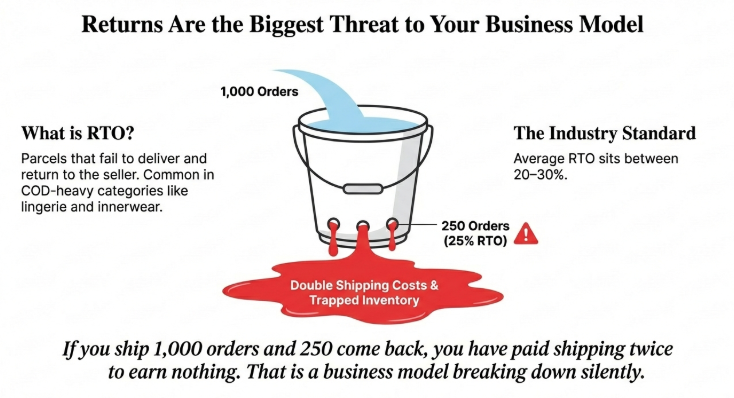
RTO — Return to Origin — happens when a parcel fails to deliver and comes back to the seller. In India's fashion ecommerce market, the average RTO rate sits between 20–30%. For some COD-heavy categories like lingerie and innerwear, it can go even higher.
What does that mean in real money? If you ship 1,000 orders a month and 250 come back, you have paid shipping twice on 250 parcels, tied up inventory, and earned nothing. That is not a small problem. That is a business model breaking down silently every single month.
At Snazzyway, we have been managing this problem since 2014. With 12+ years of experience, 4,000+ seller partnerships across India and globally, and a current RTO rate of just 3–7% — we have learned more about returns than most brands ever will.
This article is everything we know — shared openly, because high RTO is a solvable problem.
What Exactly Is RTO — And Why Does It Happen?
RTO stands for Return to Origin. It happens when:
- The customer refuses to accept the parcel at the door
- The delivery address is wrong or incomplete
- The customer is unavailable after multiple delivery attempts
- The customer placed a fake or impulse order and changed their mind
- The product did not match expectations based on photos or description
Every one of these reasons is either preventable or manageable — and that is the key insight most fashion brands miss.
Snazzyway RTO Reality Check – Industry vs Snazzyway
| Metric | Industry Average | Snazzyway |
|---|---|---|
| Overall RTO Rate | 20–30% | 3–7% |
| COD RTO Rate | 25–35% | 5–8% |
| Prepaid RTO Rate | 3–5% | Under 2% |
| Fake Order Rate | 8–12% | Under 1% |
| Wrong Address Returns | 5–8% | Under 1% |
| Quality-Related Returns | 10–15% | Under 2% |
| Repeat Customer RTO | 8–12% | Under 3% |
The difference between 25% RTO and 5% RTO on 1,000 monthly orders is 200 parcels — each costing double shipping. At ₹100 per round trip that is ₹20,000 saved every single month just from managing RTO better.
Section 1: The Real Financial Cost of High RTO
Most fashion sellers calculate their margins incorrectly because they do not account for the full cost of RTO. Here is the real math:
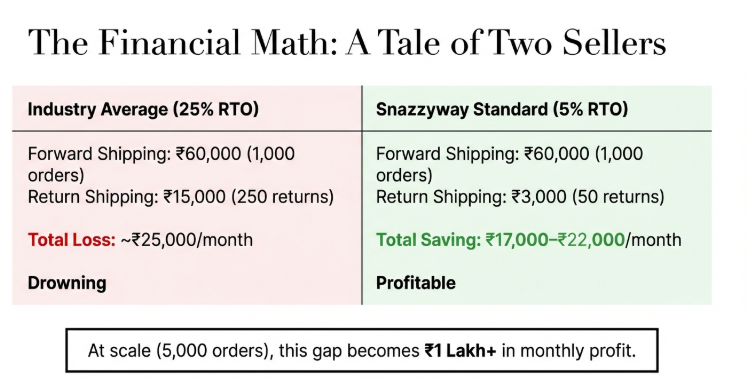
Scenario: 1,000 COD Orders at 25% RTO
| Item | Cost |
|---|---|
| Forward Shipping (1,000 orders × ₹60) | ₹60,000 |
| Return Shipping (250 returns × ₹60) | ₹15,000 |
| Total Shipping Cost | ₹75,000 |
| Effective Cost per Successful Delivery | ₹100 per order |
| Lost Revenue (250 undelivered orders) | Depends on margin |
| Repackaging & Restocking Cost | ₹5,000 – ₹10,000 |
| Total Avoidable Loss | ₹20,000 – ₹25,000 / month |
Same Scenario at 5% RTO
| Item | Cost |
|---|---|
| Forward Shipping (1,000 orders × ₹60) | ₹60,000 |
| Return Shipping (50 returns × ₹60) | ₹3,000 |
| Total Shipping Cost | ₹63,000 |
| Effective Cost per Successful Delivery | ₹66 per order |
| Monthly Saving vs 25% RTO | ₹17,000 – ₹22,000 |
At scale — 5,000 orders per month — that saving becomes ₹85,000 to ₹1,10,000 every single month. That is the difference between a profitable fashion business and one that is slowly drowning.
Section 2: Top Reasons Why Fashion Parcels Come Back in India
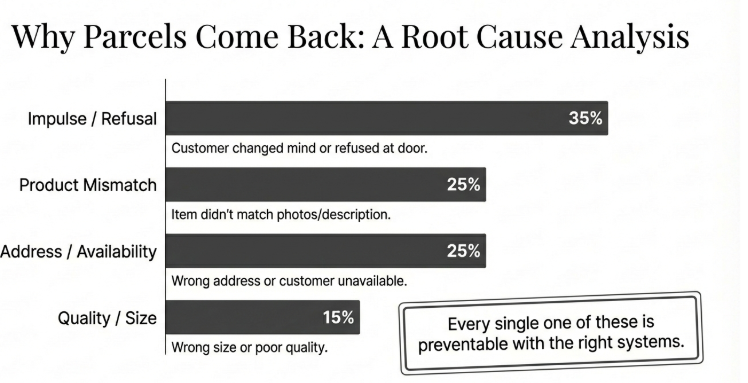
Understanding why RTO happens is the first step to fixing it. Here are the most common reasons — and how common each one is:
| Reason | Estimated Contribution to RTO |
|---|---|
| Customer refused at door (impulse order) | 30–35% |
| Product did not match photos/description | 20–25% |
| Wrong or incomplete delivery address | 10–15% |
| Customer unavailable / not picking calls | 10–15% |
| Size mismatch / wrong size ordered | 10–12% |
| Fake or prank orders | 5–8% |
| Delayed delivery — customer lost interest | 5–8% |
Notice something? Every single one of these is preventable. Not partially preventable — fully preventable with the right systems in place.
✅ Pros & Cons – The RTO Reality for Fashion Sellers
| ✅ What Low RTO Gives You | ⚠️ What High RTO Costs You |
|---|---|
| Higher profit per order | Double shipping costs |
| Better cash flow | Delayed revenue |
| Lower logistics costs | Inventory tied up in transit |
| Faster business scaling | Working capital pressure |
| Better courier relationships | Poor courier priority scores |
| Reinvestment capacity | Constant firefighting |
| Happy team & smooth operations | Operational chaos |
💡 Snazzyway Insight: What 12 Years of Managing RTO Taught Us
"In our early years, we had months where RTO touched 18–20%. We were shipping hard, working hard, and still losing money. That is when we realized — the problem was not our product. The problem was our systems."
Here is what 12+ years of managing returns at scale — across 4,000+ seller partnerships and millions of orders — has taught the Snazzyway team:
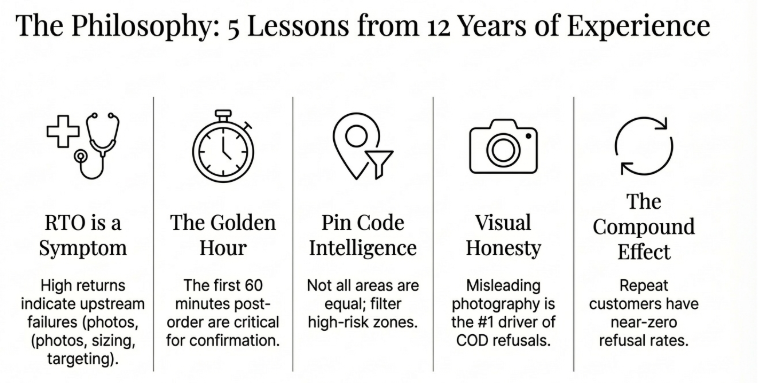
Lesson 1: RTO is a symptom, not a disease.
High RTO tells you something is broken upstream. Either your product photos are misleading, your size charts are wrong, your target audience is not the right fit, or your delivery communication is poor. Fix the upstream problem and RTO fixes itself.
Lesson 2: The first 24 hours after order placement are critical.
An order confirmation WhatsApp message sent within 1 hour of purchase reduces cancellations and refusals dramatically. The customer feels engaged, confirmed, and mentally committed to receiving the parcel.
Lesson 3: Not all pin codes are equal.
Some pin codes in India have structurally high RTO rates — often due to limited courier reliability, high fraud concentration, or difficult access. Identifying and managing these pin codes separately saved Snazzyway thousands of rupees every month.
Lesson 4: Quality photos reduce returns more than any other single investment.
When a customer receives a product that looks exactly like the photo — same color, same fit, same fabric feel — she pays at the door without hesitation. Misleading photography is the single biggest driver of COD refusals in fashion.
Lesson 5: Repeat customers have dramatically lower RTO.
A customer who has received 3 good orders from you has a near-zero refusal rate. Every investment you make in delivering a great first experience pays compound returns through lower RTO on every subsequent order.
— The Snazzyway Team, Delhi (Since 2014)
Section 3: How Snazzyway Keeps RTO at 3–7% — The Exact System
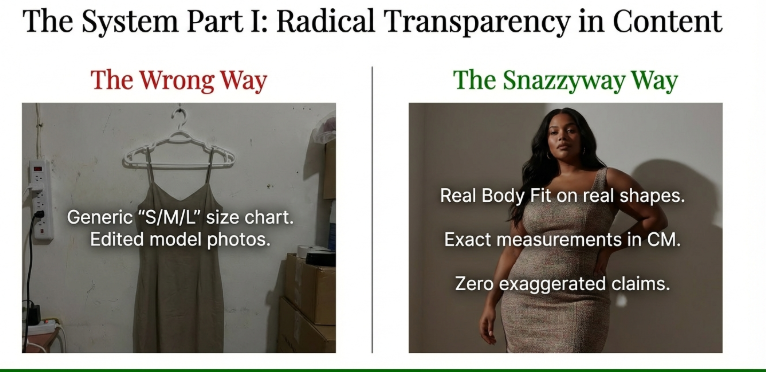
This is the part most brands want to know. Here is exactly how Snazzyway manages RTO at scale:
Step 1 — Product Photography That Shows Real Fit
Every product on Snazzyway is photographed on real body shapes — not just hanger shots or heavily edited model photos. Customers see exactly what they will receive. This one change reduced quality-related returns by over 60% in our early years.
Step 2 — Size Charts That Actually Match the Product
Snazzyway maintains standardized size charts that are tested against actual garment measurements — not just industry guidelines. Every product page shows exact measurements in centimeters so customers can measure themselves before ordering.
Step 3 — Order Confirmation Communication
Within 1 hour of every order, the customer receives an order confirmation on WhatsApp or SMS. This simple step reduces impulse cancellations and keeps the customer mentally engaged with their purchase.
Step 4 — Pre-Delivery Reminder
One day before delivery, the customer receives a message: "Your Snazzyway order arrives tomorrow. Please keep ₹XXX ready." This single message is responsible for a significant portion of our RTO reduction — customers who are reminded are customers who answer the door.
Step 5 — Smart COD Fraud Filtering
Our system automatically flags orders from pin codes with historically high fraud rates, unusually large first-time COD orders, and incomplete address patterns. These orders are either verified by a quick call or converted to prepaid before dispatch.
Step 6 — Fast Reverse Logistics
When a return does happen, Snazzyway's reverse logistics process ensures the product is back in the warehouse, quality-checked, and restocked within 48–72 hours. This minimizes inventory dead time and keeps stock available for the next order.
Section 4: Practical Steps Every Fashion Brand Can Take Today
You do not need Snazzyway's scale to apply these principles. Here are steps any fashion seller can take starting this week:
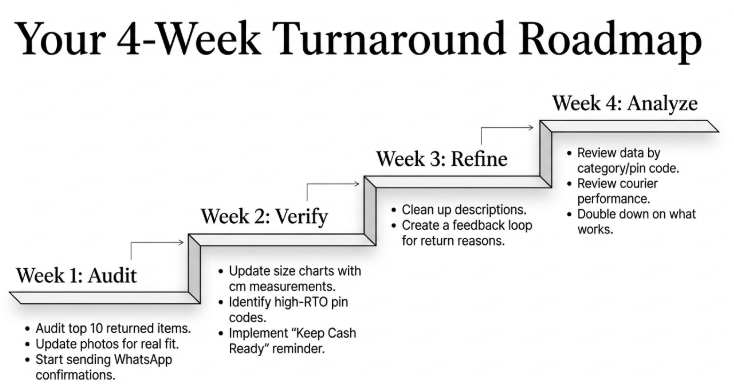
Week 1 Actions
- Audit your top 10 returned products and identify the common reason
- Update product photos to show real fit and accurate color
- Set up a basic WhatsApp message to send after every order
Week 2 Actions
- Create or update size charts with actual garment measurements
- Identify your top 5 high-RTO pin codes and add a COD verification step
- Add a pre-delivery reminder message 24 hours before expected delivery
Week 3 Actions
- Review your product descriptions for accuracy — remove any exaggerated claims
- Set up a simple feedback loop to track why returns are happening
- Consider offering a small prepaid discount to reduce COD exposure
Week 4 Actions
- Analyze your RTO data by product category, pin code, and order size
- Double down on what is working and eliminate what is not
- Review courier performance — some couriers have structurally higher RTO rates
Section 5: How Structured Fashion Supply Chains Solve the RTO Problem
One of the most underappreciated solutions to high RTO is working with a supply chain that has already solved the problem at scale.
Independent fashion sellers trying to manage quality control, size standardization, photography standards, COD verification, and reverse logistics on their own are fighting too many battles simultaneously. Most lose — not because they are bad at business, but because each of these systems takes years to build properly.
This is exactly why thousands of sellers across India choose to partner with structured women's fashion dropshipping suppliers in India who have already built these systems — instead of trying to reinvent every wheel from scratch.
When your supply chain partner has 12+ years of RTO management experience, 4,000+ seller relationships, and a proven 3–7% RTO rate — you inherit those systems the moment you start working with them. That is not just convenience. That is a serious competitive advantage.
Section 6: The Future of RTO Management in Indian Fashion
The industry is moving fast on RTO solutions. Here is what is coming:
AI-based fraud detection is already being used by large platforms like Meesho and Amazon to flag high-risk COD orders before dispatch. Smaller sellers will have access to similar tools through their logistics partners within the next 2–3 years.
UPI-on-delivery is reducing pure cash COD, which carries the highest fraud risk. As more customers adopt UPI payments at the door, fake order rates will drop significantly.
Hyperlocal delivery in Tier 2 and Tier 3 cities is improving delivery success rates by using local delivery partners who know the area, speak the local language, and can actually find customers at home.
Video unboxing as a return policy condition is being tested by several brands — asking customers to record a video while opening the parcel before a return is accepted. This alone reduces fake "wrong product" claims dramatically.
The brands that invest in understanding and managing RTO today will have a structural cost advantage over competitors who ignore it — and that advantage only compounds over time.
Conclusion: RTO Is a Solvable Problem — Start Solving It Today
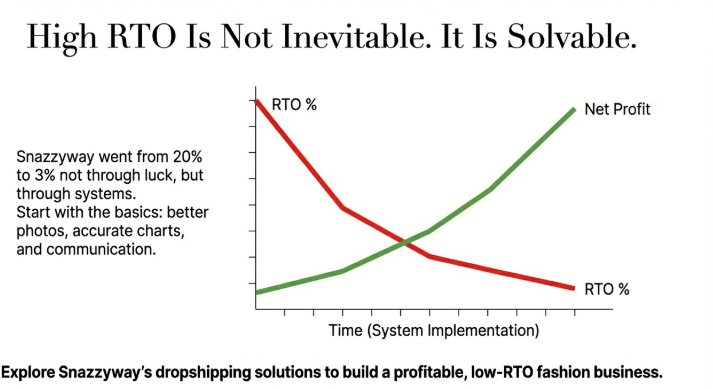
High RTO is not inevitable. It is not just "how India works." It is a systems problem with a systems solution.
Snazzyway went from 18–20% RTO in our early years to a consistent 3–7% today — not through luck, but through building the right systems one step at a time over 12+ years.
The brands that survive and scale in Indian fashion ecommerce will be the ones that treat RTO as a priority — not an afterthought. Every percentage point of RTO you reduce is money that goes directly into your profit margin.
Start with the basics: better photos, accurate size charts, and a simple pre-delivery message. Those three changes alone can cut your RTO by 30–40% within 60 days.
And if you want to skip years of trial and error and plug into a supply chain that has already solved RTO at scale — explore how India's most trusted women's clothing and lingerie dropshipping platform is helping 4,000+ sellers build profitable, low-RTO fashion businesses across India.
You must login to post a comment.

FAQs
Find answers to the most common questions below.
Related Articles
You may also like these posts
What 10,000+ Reviews Taught Us in 12 Years
Aug 09, 2026
Why We Rebuilt the Snazzyway Review System
Aug 09, 2026
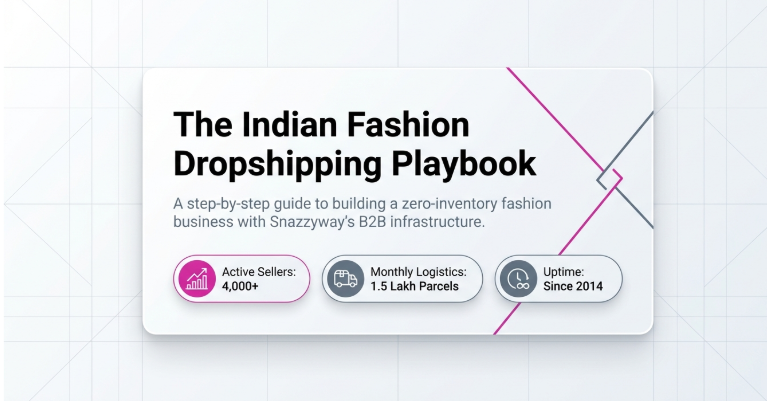
How Snazzyway Works — A Complete Guide for New Dropshipping Sellers in India
Mar 30, 2026
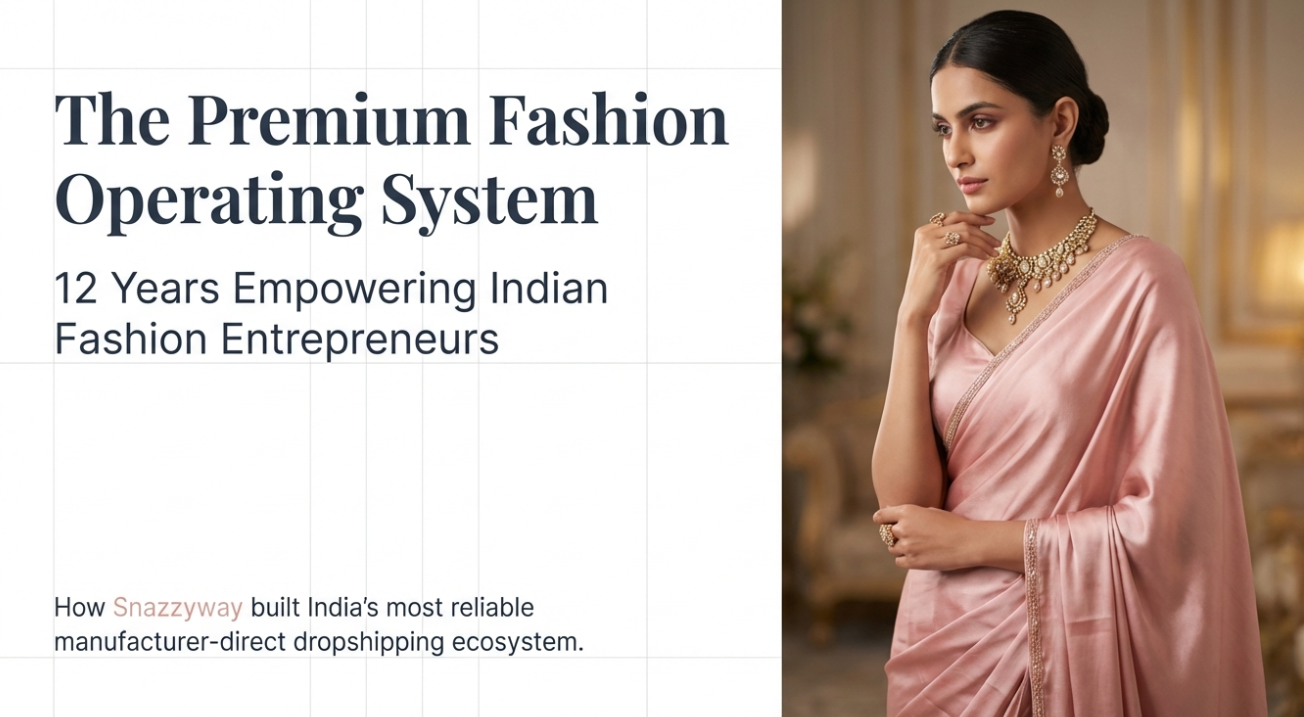
How Snazzyway Has Supported Indian Fashion Sellers for 12 Plus Years
Mar 30, 2026
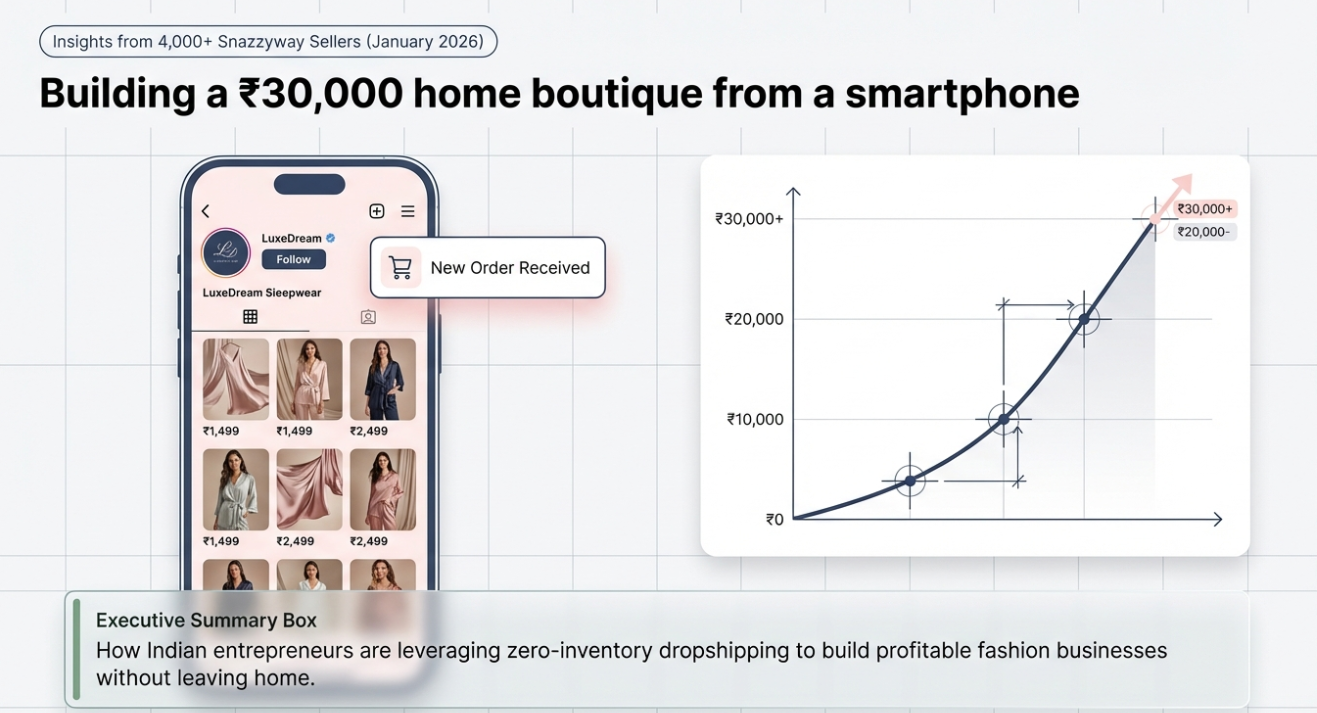
How Indian Housewives Are Earning ₹30,000 a Month Selling Online From Home
Mar 30, 2026