Snazzyway Explains: The Real Cost of Wholesale Clothing vs Inventory-Free Fashion Selling in India
Published by Snazzyway.com | India's Leading Women's Clothing & Lingerie Brand Since 2014 💰 Business & Finance | ⏱ 9 min read |
What is the real cost difference between wholesale clothing and inventory-free fashion selling in India?
Wholesale buying requires ₹20,000–₹1,00,000+ upfront capital with high inventory and RTO risk. Inventory-free selling requires near-zero capital, eliminates stock risk, and lets sellers start profitably from day one — making it the smarter model for most Indian fashion entrepreneurs in 2026.
🔖 Quick Summary
- The complete cost breakdown of wholesale buying vs inventory-free selling in India
- Why most new fashion sellers overestimate wholesale profits and underestimate risks
- Real numbers — capital required, margins, RTO costs, and monthly profit comparison
- Hidden costs of wholesale that nobody talks about upfront
- Honest Pros & Cons of both models for Indian fashion sellers
- Snazzyway Insight: 12+ years of watching both models succeed and fail
- Which model is right for you — a simple decision framework
- Frequently asked questions answered
Introduction: Everyone Talks About Margins — Nobody Talks About Real Costs
When new fashion sellers in India start researching how to build their business, they almost always have the same conversation with themselves:
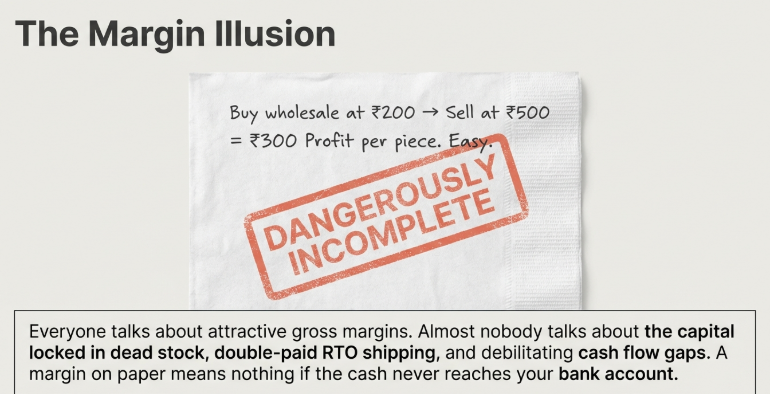
"If I buy wholesale at ₹200 and sell at ₹500 — that is ₹300 profit per piece. At 100 pieces a month that is ₹30,000 profit. This is easy."
This calculation is not wrong. It is just dangerously incomplete.
It does not account for the capital locked in unsold inventory. The storage costs. The pieces that come back as returns. The shipping you paid twice on returned COD orders. The cash flow gap between buying stock and receiving payment. The pieces that go out of season before they sell.
At Snazzyway, we have been working with 4,000+ fashion sellers across India and globally since 2014. In 12+ years, we have seen hundreds of sellers start with wholesale buying — and we have seen exactly how many of them quietly switched to inventory-free models after experiencing the real cost of wholesale firsthand.
This article puts the actual numbers on the table — honestly, completely, and without bias. By the end, you will know exactly which model makes financial sense for your situation.
First — Let Us Define Both Models Clearly
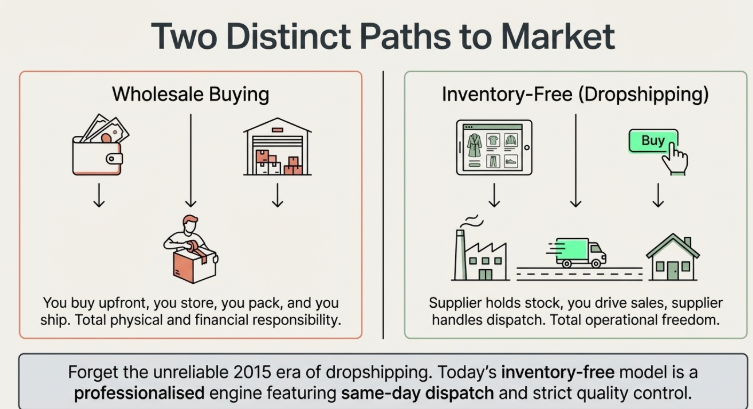
Before the numbers, let us make sure both models are crystal clear:
| Model | How It Works | Who Holds Inventory |
|---|---|---|
| Wholesale Buying | You buy stock upfront in bulk, store it, sell it, and ship orders yourself | You — the seller |
| Inventory-Free Selling | You list supplier products, take orders first, and supplier ships to customer | The supplier |
The inventory-free model is also called dropshipping — and in India specifically, it has evolved significantly from the unreliable, low-quality model it had a reputation for in 2015–2018. Today, with suppliers like Snazzyway offering same-day dispatch, 3–7% RTO, and own-manufacturing quality control — inventory-free selling is a genuinely professional business model.
The Complete Cost Comparison — Real Numbers
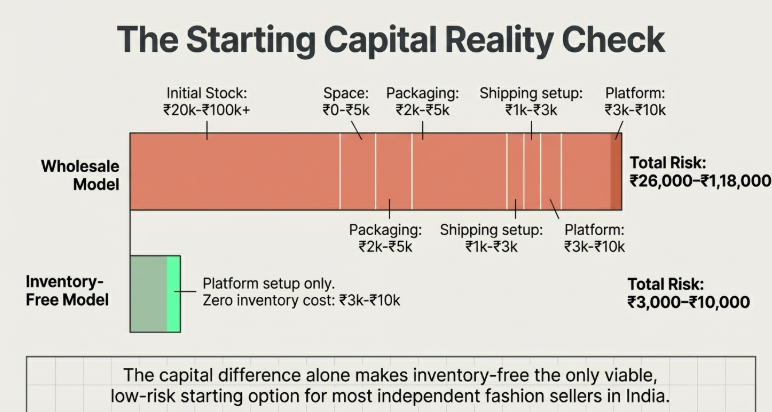
Starting Capital Required
| Cost Component | Wholesale Model | Inventory-Free Model |
|---|---|---|
| Initial stock purchase | ₹20,000–₹1,00,000+ | ₹0 |
| Storage/warehouse space | ₹0 (home) to ₹5,000+/month | ₹0 |
| Packaging materials | ₹2,000–₹5,000 upfront | ₹0 (supplier handles) |
| Shipping setup | ₹1,000–₹3,000 (courier account) | ₹0 (supplier handles) |
| Platform/website setup | ₹3,000–₹10,000 | ₹3,000–₹10,000 |
| Total Starting Capital | ₹26,000–₹1,18,000+ | ₹3,000–₹10,000 |
The capital difference alone is enough to make inventory-free the only viable starting option for most new sellers in India. But starting capital is just the beginning.
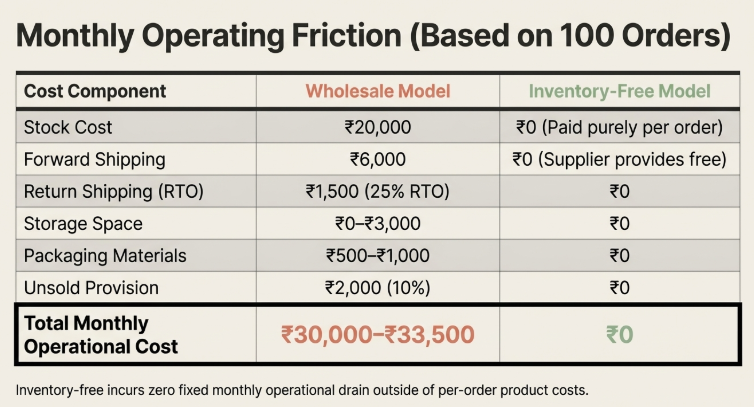
Monthly Operating Cost Comparison — 100 Orders Per Month
| Cost Component | Wholesale Model | Inventory-Free Model |
|---|---|---|
| Stock cost (100 units × ₹200) | ₹20,000 | ₹0 (paid per order) |
| Shipping cost (100 orders × ₹60) | ₹6,000 | ₹0 (supplier provides free) |
| Return shipping (25% RTO × ₹60) | ₹1,500 | ₹0 |
| Storage/space cost | ₹0–₹3,000 | ₹0 |
| Packaging materials | ₹500–₹1,000 | ₹0 |
| Unsold inventory provision (10%) | ₹2,000 | ₹0 |
| Total Monthly Operational Cost | ₹30,000–₹33,500 | Product cost only |
Revenue and Profit Comparison — 100 Orders Per Month
| Metric | Wholesale Model | Inventory-Free Model |
|---|---|---|
| Selling price per unit | ₹500 | ₹500 |
| Gross revenue (100 orders) | ₹50,000 | ₹50,000 |
| Less: Stock cost | -₹20,000 | -₹22,000 (supplier price) |
| Less: Shipping (forward) | -₹6,000 | ₹0 |
| Less: RTO returns | -₹1,500 (25% RTO) | -₹300 (3% RTO) |
| Less: Packaging | -₹750 | ₹0 |
| Less: Unsold stock | -₹2,000 | ₹0 |
| Less: Platform fees (5%) | -₹2,500 | -₹2,500 |
| Net Monthly Profit | ~₹17,250 | ~₹25,200 |
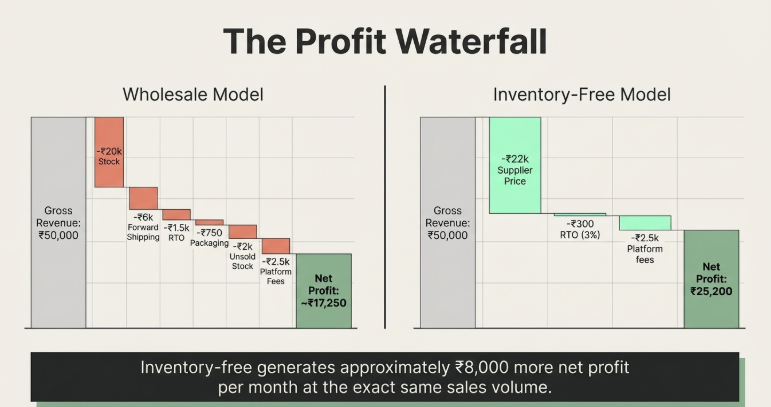
The inventory-free model generates approximately ₹8,000 more profit per month at the same sales volume — because of zero shipping cost, dramatically lower RTO losses, and zero unsold inventory risk.
At 500 orders per month, that difference becomes ₹40,000+ per month. At 1,000 orders per month — over ₹80,000 per month.
Section 1: The Hidden Costs of Wholesale That Kill Margins
This is where the wholesale calculation gets honest. Here are the costs most wholesale sellers discover only after they have already committed:
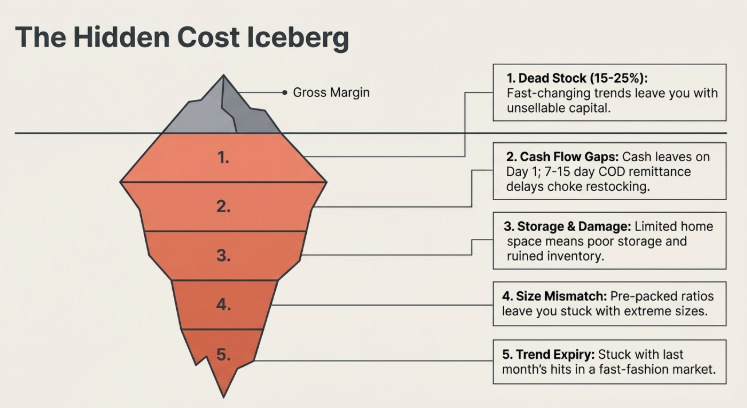
Hidden Cost 1 — Dead Stock
When you buy 50 pieces of a design wholesale and only 30 sell — you have 20 pieces of dead stock. You paid for them. They are sitting somewhere. Their capital is locked and not earning.
In fashion specifically, dead stock risk is very high because:
- Trends change fast
- Size distribution is unpredictable
- Color preferences vary by region
- Seasonal shifts can strand inventory overnight
Dead stock provision for realistic wholesale planning: 15–25% of stock value.
Hidden Cost 2 — Cash Flow Gap
When you buy wholesale, cash goes out immediately. Revenue comes in over weeks and months — and for COD orders, after a 7–15 day courier remittance delay on top of that.
The cash flow gap — the period between paying for stock and receiving payment — is one of the most common reasons wholesale fashion businesses stall. You cannot restock because last month's cash is still tied up in stock or in courier remittance.
Hidden Cost 3 — Storage and Damage
Storing inventory at home works at small scale. At 200+ pieces, you need dedicated space — which either costs money or degrades your living environment. Fashion items stored improperly get damaged, dusty, or deformed. Damaged stock that you paid full wholesale price for and cannot sell is pure loss.
Hidden Cost 4 — Size and Variant Mismatch
Wholesale fashion comes in size packs. A typical size pack might be 1×S, 2×M, 2×L, 1×XL. But your customers may predominantly be M and L — leaving you with S and XL pieces that do not sell.
This is especially problematic in lingerie and innerwear — where size distribution is highly variable and size-specific demand is impossible to predict accurately without deep customer data.
Hidden Cost 5 — Trend Timing Risk
Fashion has short trend cycles. A design that is hot in October may be stale by December. Wholesale buyers who stock up on a trending design often find the trend has passed before their inventory clears — leaving them with marked-down stock that barely covers cost.
Section 2: The Hidden Advantages of Inventory-Free Selling That Most Sellers Underestimate
| Advantage | What It Actually Means |
|---|---|
| Zero capital at risk | Every rupee can be used for marketing and growth instead of inventory |
| Infinite catalog | List 500+ products without buying a single piece |
| Zero trend risk | Remove slow sellers instantly with no sunk cost |
| Test before committing | Identify winning products without financial exposure |
| Cash flow positive from day one | No capital gap between buying and selling |
| Scale without warehouse | Grow from 10 to 1,000 orders without storage limitations |
| No size distribution gamble | Customer orders exact size — supplier fulfills accordingly |
| Focus entirely on selling | No time spent on packing, shipping, or handling returns |
The last point deserves emphasis. Wholesale sellers spend significant time every day on operational tasks — receiving stock, checking quality, packing orders, booking couriers, tracking shipments, processing returns. Inventory-free sellers do none of this. All of that time goes into selling, marketing, and building customer relationships.
This operational freedom is one of the biggest reasons inventory-free sellers often scale faster than wholesale sellers with similar talent and effort — and it is a core reason why India's fashion ecommerce market is growing 3X faster than offline retail, driven largely by inventory-free resellers who can enter and scale without traditional retail infrastructure.
✅ Pros & Cons — Wholesale vs Inventory-Free
| ✅ Wholesale Model | ✅ Inventory-Free Model | |
|---|---|---|
| Pros | Higher per-unit margin possible | Zero starting capital needed |
| Full physical control of stock | No dead stock risk | |
| Can negotiate bulk pricing | Infinite scalable catalog | |
| Independent of supplier dispatch speed | Free shipping via supplier | |
| Custom packaging possible from start | Focus on selling, not operations | |
| Cons | High starting capital required | Slightly lower per-unit margin |
| Dead stock risk always present | Dependent on supplier quality | |
| Cash flow gaps from COD remittance | Less control over packaging | |
| Storage space needed at scale | Supplier dispatch speed is critical | |
| Size and trend risk on every order | Cannot physically inspect stock |
💡 Snazzyway Insight: What We Observed Across 4,000+ Seller Journeys

"When we started in 2014, almost all of our seller partners were buying wholesale from us. By 2019, the majority had shifted to inventory-free models — not because we pushed them, but because the math became undeniable as they scaled."
Here is what 12+ years of watching sellers operate both models across India has taught us:
Wholesale works best as a later-stage strategy, not a starting strategy.
The sellers who succeed with wholesale buying are typically those who have already proven their product-market fit through inventory-free selling first. They know exactly which products sell in their market, which sizes move fastest, and which designs repeat well. With that knowledge, bulk buying makes sense — because they are buying proven winners in known quantities.
Sellers who start with wholesale before proving their market are essentially gambling. Most lose.
The RTO difference between models is the most underappreciated financial factor.
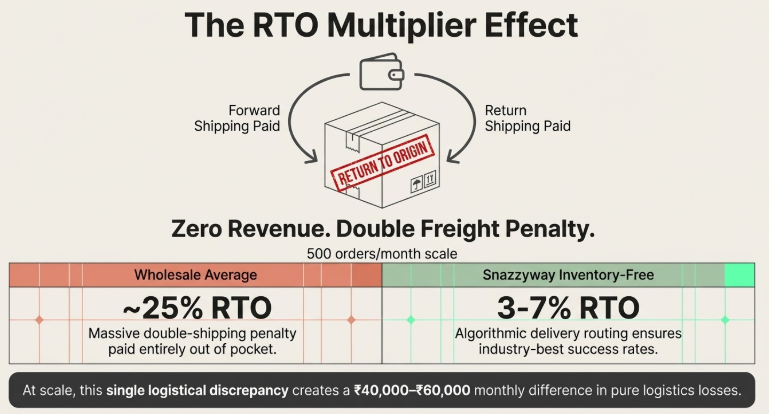
Wholesale sellers with 25% RTO pay double shipping on every returned parcel — from their own pocket. Inventory-free sellers working with Snazzyway's 3–7% RTO infrastructure pay a fraction of that cost. At 500 orders per month, this single factor creates a ₹40,000–₹60,000 monthly difference in logistics costs alone.
Understanding the full financial impact of high RTO on fashion business margins is essential for any seller evaluating these two models — because RTO costs are almost never included in the simple margin calculations sellers do at the start.
The best sellers we have worked with treat inventory-free as a permanent competitive advantage — not just a starting phase.
Many of our top-performing seller partners — doing ₹5,00,000+ monthly revenue — still operate primarily on inventory-free models. They use the capital they save on inventory to invest in marketing, customer acquisition, and brand building. The result: faster growth, better margins, and businesses that scale without the operational complexity of managing physical stock.
For sellers who want to understand the full picture of what it takes to build a successful fashion business in India — our guide on 10 things every woman should know before starting an online fashion business covers the model decision in depth alongside nine other critical decisions.
— The Snazzyway Team, Delhi (Since 2014)
Section 3: When Does Wholesale Actually Make Sense?
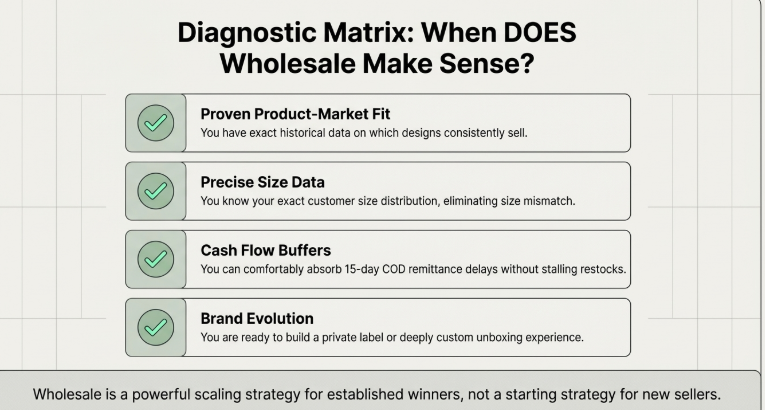
Wholesale buying is not always the wrong choice. Here are the specific scenarios where it makes financial sense:
| Scenario | Why Wholesale Makes Sense |
|---|---|
| Proven product demand | Buying in bulk locks in lower per-unit cost |
| Customer size distribution data available | Reduces size mismatch and return risk |
| Storage infrastructure ready | Physical handling becomes cost-effective at scale |
| Need custom packaging/branding | Requires owning and managing inventory |
| Supplier offers strong bulk discounts | Price difference justifies upfront capital investment |
| COD cash flow is managed | You can handle delayed payments without liquidity issues |
| Building a private label brand | Inventory ownership is essential for full brand control |
If none of these scenarios apply to you — wholesale is not the right model yet. Start inventory-free, prove your market, build your cash flow, and consider wholesale selectively once you have the data and capital to make it work.
Section 4: The Real Decision Framework — Which Model Is Right for You?
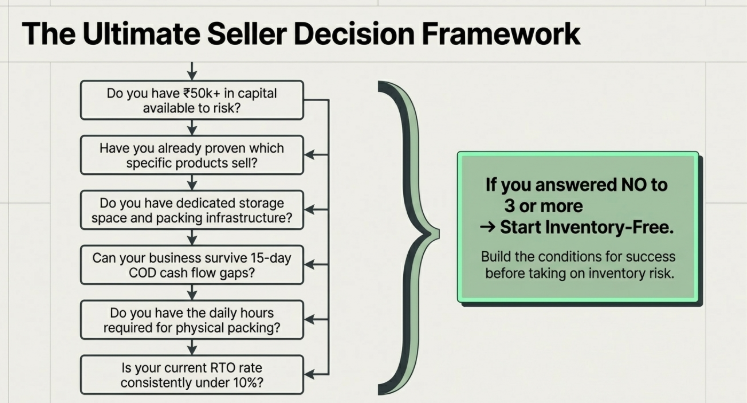
Answer these questions honestly:
| Question | Wholesale | Inventory-Free |
|---|---|---|
| Do you have ₹50,000+ available capital to risk? | ✅ Proceed | ❌ Start here |
| Have you proven which products sell in your market? | ✅ Proceed | ❌ Start here |
| Do you have storage space and packing infrastructure? | ✅ Proceed | ❌ Start here |
| Can you manage 7–15 day COD cash flow gaps? | ✅ Proceed | ❌ Start here |
| Do you have time for daily packing and shipping? | ✅ Proceed | ❌ Start here |
| Is your RTO rate consistently under 10%? | ✅ Proceed | ❌ Start here |
If you answered ❌ to 3 or more questions — inventory-free is clearly the right starting model for you.
The biggest challenges faced by online resellers in India almost always trace back to starting with wholesale before the conditions for wholesale success are in place. Inventory-free removes the risk while you build those conditions.
Section 5: How Inventory-Free Works in Practice — A Real Example
Let us walk through a realistic month for an inventory-free fashion seller in India:
The Seller: Priya, 28, from Lucknow. Sells women's lingerie and nightwear on WhatsApp and Instagram. Uses Snazzyway as her supplier.
| Week / Stage | Activity | Financial Impact |
|---|---|---|
| Week 1 | Lists 15 products from supplier catalog on WhatsApp & Instagram | ₹0 spent |
| Week 1 | Takes 40 orders at ₹450 average selling price | ₹18,000 collected |
| Week 1 | Places orders with supplier (₹250 avg product cost) | ₹10,000 paid |
| Week 2 | Supplier dispatches same day, all 40 orders shipped | ₹0 shipping cost |
| Week 2 | 38 orders delivered (≈95% success, 3–7% RTO) | 2 returns handled by supplier |
| Week 3 | Takes another 45 orders — reinvests week 1 profit | Growth funded by revenue |
| Week 4 | Month total: 160 orders, ₹72,000 revenue, ₹40,000 product cost | ₹32,000 gross profit |
| End of Month | After platform fees & marketing | Net profit ~₹24,000–₹26,000 |
| Summary | First month with inventory-free model | ₹0 starting capital required |
Priya started with ₹0 inventory investment. Her capital was never at risk. Her time was spent entirely on selling and customer relationships — not packing, shipping, or chasing returns.
This is inventory-free selling in practice. This is why Tier 2 India women are becoming fashion resellers faster than metro cities — because the inventory-free model removes every financial barrier that previously made fashion entrepreneurship inaccessible.
About Snazzyway — India's Leading Inventory-Free Fashion Platform
Snazzyway has been India's leading women's clothing and lingerie supplier since 2014 — with own manufacturing since 2016, Snazzyway Fly cloud platform since 2023, and 4,000+ active seller partnerships across India and globally.
For inventory-free sellers specifically, Snazzyway provides:
- ✅ Zero inventory requirement — list and sell without buying
- ✅ Premium & Plus Size catalog — high-demand, high-margin categories
- ✅ Free pan-India shipping on every order
- ✅ Same-day dispatch before cut-off
- ✅ Industry-best 3–7% RTO rate
- ✅ Own manufacturing quality control from source
- ✅ Snazzyway Fly — real-time inventory, automated orders, tracking
- ✅ Returns managed by Snazzyway — not the seller
The platform Snazzyway has built for its reseller partners is specifically designed to make inventory-free selling as professional, reliable, and scalable as possible — so sellers can focus entirely on growing their business.
Fashion entrepreneurs who want to start or scale an inventory-free fashion business with India's most trusted supply chain can explore our women's clothing and lingerie dropshipping platform — and begin building their business today without capital risk.
Conclusion: The Model That Lets You Start Smart and Scale Fast
The real cost comparison between wholesale and inventory-free fashion selling in India is not even close for most sellers — especially those starting out.
Wholesale requires ₹26,000–₹1,18,000+ to start, carries dead stock and RTO risk, and locks capital that could be invested in marketing and growth. Inventory-free requires ₹3,000–₹10,000 to start, carries zero stock risk, and keeps your capital free for the activities that actually grow a business.
The math speaks clearly. And 4,000+ seller partners who have built their businesses on Snazzyway's inventory-free model have proven it with results.
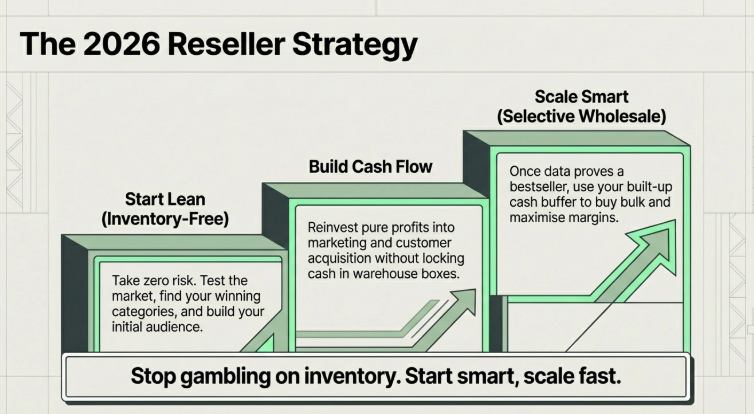
Start with inventory-free. Prove your market. Build your cash flow and customer base. Then — if and when the conditions are right — add selective wholesale buying for your proven bestsellers.
That is the sequence that builds sustainable, profitable fashion businesses in India in 2026.
❓ Frequently Asked Questions (FAQ)
Q1. Is inventory-free fashion selling more profitable than wholesale in India? In most cases, yes — especially for new and growing sellers. While wholesale offers higher per-unit margins on paper, inventory-free selling eliminates dead stock losses, shipping costs, RTO double-shipping expenses, and capital risk. The net profit per order is often higher with inventory-free when all real costs are included.
Q2. How much capital do I need to start wholesale fashion selling in India? Realistic starting capital for wholesale fashion selling in India is ₹26,000–₹1,18,000+ depending on category, quantity, and storage setup. This capital is at risk until stock sells. Inventory-free selling, by contrast, requires only ₹3,000–₹10,000 for platform and tool setup with zero inventory capital at risk.
Q3. What is the biggest hidden cost in wholesale fashion selling in India? Dead stock is typically the largest hidden cost — pieces that are bought but never sell due to wrong size distribution, trend changes, or demand miscalculation. A realistic dead stock provision of 15–25% of stock value should be included in any honest wholesale margin calculation.
Q4. How does RTO affect the profitability comparison between wholesale and inventory-free? Wholesale sellers with 25% RTO pay double shipping on every returned parcel from their own pocket. Inventory-free sellers using Snazzyway's infrastructure experience 3–7% RTO — with return shipping also managed by the supplier. At 500 orders per month, this single factor creates a ₹40,000–₹60,000 monthly cost difference.
Q5. Can I switch from wholesale to inventory-free selling in India? Yes — and many sellers make this transition. Start by identifying which of your current products are available through an inventory-free supplier. Gradually shift new product listings to inventory-free while running down your existing wholesale stock. Most sellers complete the transition within 2–3 months and report significant improvement in cash flow and operational simplicity.
Q6. Does inventory-free fashion selling work for Shopify stores in India? Yes. Inventory-free selling integrates seamlessly with Shopify through supplier platforms with digital order management. For a complete guide on this integration, our article on how to connect your Shopify store with an Indian fashion supplier covers the full technical and operational setup.
Q7. When should a fashion seller in India consider switching to wholesale buying? Consider wholesale buying when: you have proven which specific products sell consistently in your market, you have sufficient capital to risk without impacting cash flow, you have storage infrastructure, you can manage COD remittance delays, and your RTO rate is already below 10%. Most sellers reach this stage after 6–12 months of successful inventory-free selling.
Q8. How does Snazzyway's inventory-free model work for sellers? Snazzyway's inventory-free model allows sellers to list products from Snazzyway's catalog, take orders from their customers, and place those orders with Snazzyway — which then ships directly to the end customer with free pan-India delivery and same-day dispatch. Sellers pay only for orders placed, carry zero inventory, and benefit from Snazzyway's 3–7% RTO infrastructure and own-manufacturing quality control.
You must login to post a comment.

Related Articles
You may also like these posts
What 10,000+ Reviews Taught Us in 12 Years
Aug 09, 2026
Why We Rebuilt the Snazzyway Review System
Aug 09, 2026
How Snazzyway Works — A Complete Guide for New Dropshipping Sellers in India
Mar 30, 2026
How Snazzyway Has Supported Indian Fashion Sellers for 12 Plus Years
Mar 30, 2026
How Indian Housewives Are Earning ₹30,000 a Month Selling Online From Home
Mar 30, 2026