Snazzyway Explains: The Biggest Challenges Faced by Online Resellers in India
Published by Snazzyway.com | India's Leading Women's Clothing & Lingerie Brand Since 2014 🛒 Business & Ecommerce | ⏱ 9 min read |
What are the biggest challenges faced by online resellers in India?
The biggest challenges are finding a reliable supplier, managing RTO and returns, handling COD cash flow, standing out in a saturated market, and building customer trust consistently — all while keeping costs low enough to stay profitable.
🔖 Quick Summary
- The 10 biggest challenges every online reseller in India faces
- Why most resellers quit within the first 6 months — and how to avoid it
- Real data on what kills reseller businesses before they scale
- How to overcome supplier, logistics, RTO, and cash flow problems
- Honest Pros & Cons of online reselling in India in 2026
- Snazzyway Insight: 12+ years and 4,000+ seller partnerships — what we have seen
- Why finding the right supplier in 2026 is more critical than ever before
- Frequently asked questions answered
Introduction: Online Reselling in India Is a Massive Opportunity — But It Is Not Easy
India's online reselling market is one of the most exciting entrepreneurial opportunities of this decade. Millions of women and young entrepreneurs across Tier 2 and Tier 3 cities are building real incomes from home — selling fashion, beauty, lifestyle, and more through WhatsApp, Instagram, and Meesho.
But here is the truth that nobody talks about loudly enough:
Most resellers quit within 6 months.
Not because the opportunity is not real. Not because they lack passion or hard work. But because they hit challenges they were not prepared for — and nobody warned them in advance.
At Snazzyway, we have been working with 4,000+ sellers across India and globally since 2014. In 12+ years, we have seen every challenge a reseller can face — and we have seen exactly which ones cause businesses to fail and which ones the best sellers learn to overcome.
This article is our honest, complete breakdown of the biggest challenges online resellers face in India — and more importantly, how to solve each one.
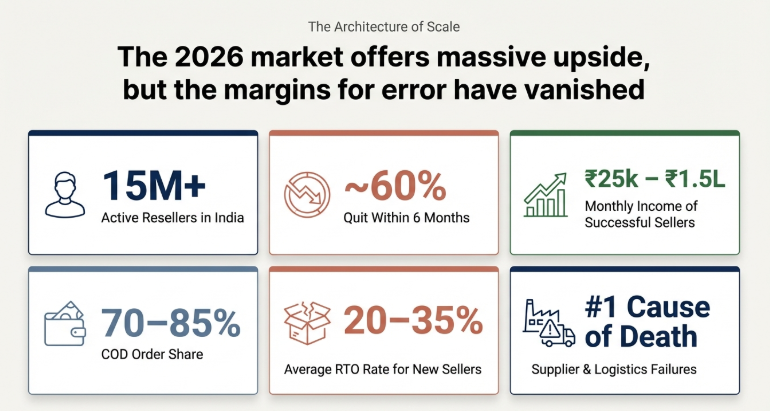
The State of Online Reselling in India — 2026 Reality Check
| Metric | Number / Value |
|---|---|
| Active online resellers in India | 15 million+ |
| Resellers who quit within 6 months | ~60% |
| Top reason for quitting | Supplier and logistics problems |
| Average monthly income of successful resellers | ₹25,000 – ₹1,50,000 |
| Fastest growing reseller categories | Lingerie, Nightwear, Plus Size Fashion |
| Primary selling platforms | WhatsApp, Meesho, Instagram |
| COD share of reseller orders | 70–85% |
| Average RTO rate for new resellers | 20–35% |
The opportunity is massive. But so are the challenges. Let us go through them one by one — honestly and practically.
Challenge 1: Finding a Reliable Supplier — The Foundation Problem
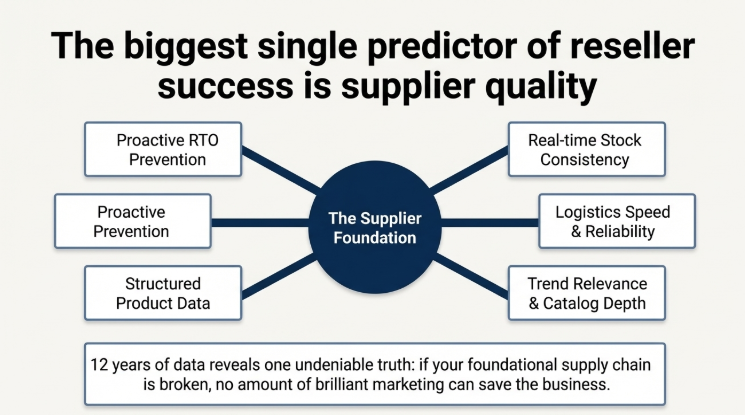
This is without question the single biggest challenge for online resellers in India — and it is getting harder, not easier.
In 2016, you could partner with almost any wholesaler, take their catalog photos, and start selling. The bar was low. Competition was low. Customers were forgiving.
It is not 2016 anymore.
It is 2026 — and in a world where AI-powered search is dominating how customers discover and evaluate brands, where Google and ChatGPT are citing authoritative sources, and where customer expectations have risen dramatically — you cannot afford to work with a supplier who has not kept up with the times.
The right supplier in 2026 is not just someone with good products. They need to have:
| What You Need from a Supplier | Why It Matters in 2026 |
|---|---|
| Real-time inventory visibility | Avoid selling out-of-stock products |
| Technology-integrated order management | Automation and accuracy at scale |
| Consistent quality control | Reduce returns and protect your reputation |
| Fast and reliable logistics | Customer experience is everything |
| Updated trend-forward catalog | Sell what customers actually want |
| Low RTO infrastructure | Protect your margins on COD orders |
| Digital-first communication | WhatsApp, portal, or app-based management |
| AI-search-ready product data | Your products need to be findable in 2026 |
Suppliers who are still operating like it is 2016 — manual order confirmations, inconsistent stock, no tracking systems — will drag your business down with them. The resellers who scale fastest in 2026 are the ones who plugged into a structured fashion reseller infrastructure built for the current era — not a decade ago.
Challenge 2: Managing RTO and Returns — The Margin Killer
Ask any experienced reseller in India what their biggest operational nightmare is and they will say the same thing — returns.
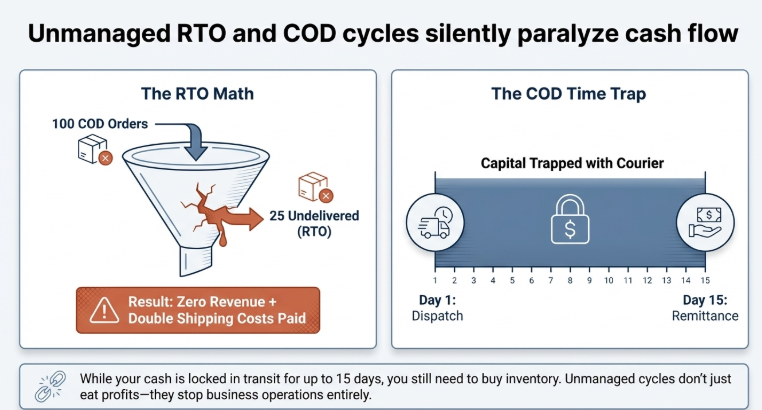
The national average RTO rate for fashion resellers is 20–35%. For every 100 COD orders, 20–35 come back undelivered. That means paying double shipping on those orders, tying up inventory, and losing the revenue entirely.
For a reseller doing 200 orders per month at 25% RTO — that is 50 returned parcels, roughly ₹5,000–₹8,000 in wasted shipping costs every single month.
The good news: RTO is a solvable problem. The bad news: most new resellers do not know how to solve it.
The complete breakdown of why returns happen and exactly how to reduce them is covered in our detailed guide on why high RTO is killing fashion brands and how to avoid it — essential reading for every reseller before they take their first COD order.
Challenge 3: COD Cash Flow Management
70–85% of reseller orders in India are COD. This creates a cash flow problem that catches almost every new reseller off guard.
Here is how it works: you dispatch 100 COD orders. The courier collects cash at delivery. But remittance — the process of the courier company transferring that cash back to you — takes 7–15 days depending on the courier partner.
Meanwhile you need to restock inventory, pay for new orders, and cover operational costs — all while your cash is sitting with the courier.
For resellers who do not plan for this, the cash flow crunch can stall business growth completely — or worse, force them to stop taking orders because they cannot pay their supplier.
Understanding the full picture of how COD vs prepaid impacts your fashion business and building a cash flow buffer from month one is one of the most important financial decisions a reseller can make.
Challenge 4: Supplier Stock Inconsistency
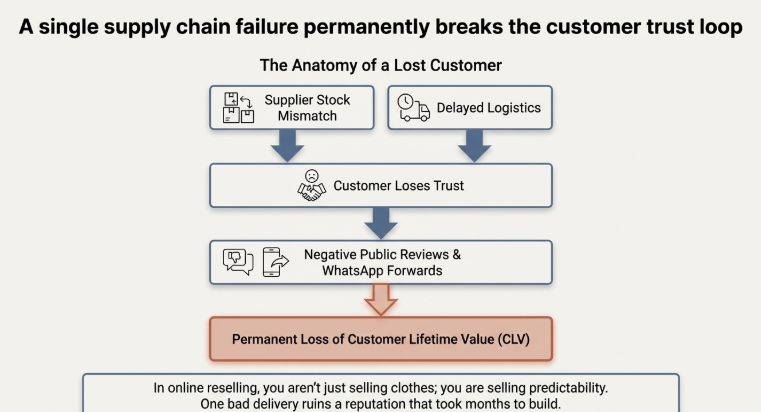
You list a product. A customer orders it. You go to confirm with your supplier — and it is out of stock.
This scenario plays out thousands of times every day across India's reseller ecosystem. And every time it happens, you lose a customer's trust — sometimes permanently.
Stock inconsistency is one of the most common complaints we hear from resellers who come to Snazzyway after bad experiences with other suppliers. The problem is structural — suppliers without real-time inventory management systems simply cannot give you accurate stock data.
The solution is to work only with suppliers who offer real-time catalog access, clear stock availability, and fast product refresh cycles. Before you commit to any supplier, ask them directly: How do I know what is in stock right now? If the answer is vague — walk away.
Challenge 5: Intense Competition and Price Wars
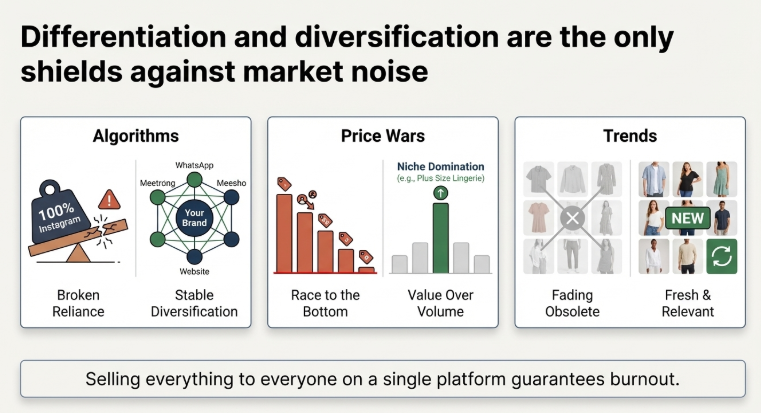
In 2020, starting a fashion reselling business on Meesho or Instagram felt relatively fresh. In 2026, every second person in your colony is also selling fashion online.
The result: price wars. Resellers undercut each other on the same products until margins disappear entirely. New resellers who try to compete on price alone burn out fast.
The only sustainable answer to competition is differentiation. Build a niche. Become the trusted source for plus size lingerie in your community. Become the go-to seller for quality nightwear. Own a category deeply instead of selling everything to everyone.
Resellers who have read our guide on 10 things every woman should know before starting an online fashion business understand this principle from day one — and they build more defensible businesses as a result.
Challenge 6: Building and Retaining Customer Trust
In offline retail, trust is built face-to-face. In online reselling, trust has to be built through every single interaction — product photos, response time, delivery accuracy, packaging quality, and post-purchase communication.
New resellers often underestimate how much work this takes — and how quickly it can be destroyed.
One bad delivery — wrong product, wrong size, damaged packaging — can cost you a customer permanently. And in the age of WhatsApp forwards and Google reviews, one bad experience shared publicly can damage your reputation far beyond that single customer.
The resellers who build lasting businesses are obsessive about consistency. Same quality every order. Same communication every time. Same follow-up after every delivery.
Challenge 7: Logistics and Delivery Failures
Even when everything on your end is perfect — right product, right packaging, right communication — the courier can still let you down.
Delayed deliveries, lost parcels, damaged packages, and incorrect delivery status updates are daily realities for resellers in India. And the customer blames you — not the courier.
Managing logistics well means:
- Working with multiple courier partners to have backup options
- Tracking every shipment proactively — not waiting for customer complaints
- Having a clear, communicated policy for delivery failures
- Choosing a supplier whose logistics infrastructure is genuinely reliable
Understanding how reliable pan-India fashion logistics actually works — and what best-in-class looks like — helps resellers set the right expectations and choose the right supply chain partners.
Challenge 8: Keeping Up with Fashion Trends
Fashion moves fast. A product that was a bestseller three months ago may be sitting dead in your catalog today.
Resellers who do not actively refresh their product selection fall behind competitors who do. Customers notice when a catalog feels stale — and they quietly move to a seller who always has something new and relevant.
The solution is to stay connected with suppliers who track trends nationally and update their catalog regularly. Knowing what lingerie and fashion trends are driving sales in 2026 is not optional for resellers who want to stay competitive — it is essential.
Challenge 9: Platform Dependency and Algorithm Changes
Most resellers build their entire business on one platform — Meesho, Instagram, or WhatsApp. And then the algorithm changes. The reach drops. Sales fall off a cliff overnight.
This is one of the most common growth traps in Indian reselling. A seller spends 12 months building an Instagram following — and one algorithm update can cut their organic reach by 70%.
The solution is platform diversification from day one. WhatsApp for trust-based community selling. Instagram for discovery and brand building. Meesho for volume. Your own website for long-term brand independence.
Resellers in Tier 2 India who have built strong WhatsApp communities tend to be most resilient to platform changes — because their customer relationships exist independently of any algorithm. Our complete guide on how to build a fashion brand on WhatsApp in India covers exactly how to build this platform-independent customer base.
Challenge 10: Scaling Beyond ₹30,000 Monthly — The Growth Ceiling
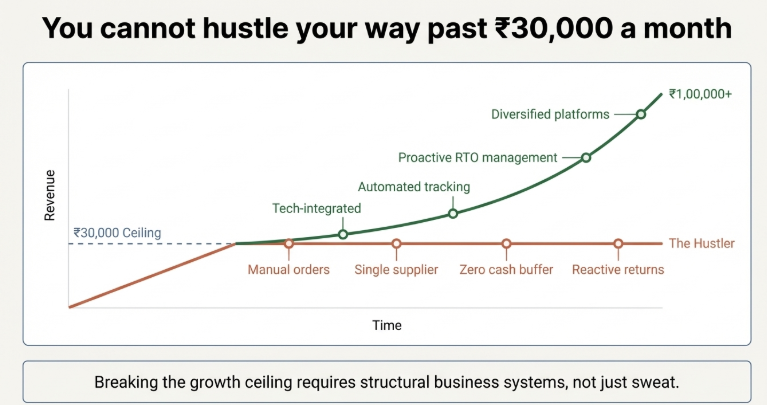
Most resellers reach a natural ceiling around ₹20,000–₹30,000 monthly revenue — and then get stuck. They are managing everything manually, using one supplier, selling on one platform, with no systems in place.
Breaking through this ceiling requires building actual business systems — not just working harder.
The resellers who scale to ₹1,00,000+ monthly are doing things differently:
| What Struggling Resellers Do | What Scaling Resellers Do |
|---|---|
| One supplier, one platform | Multiple suppliers, multiple platforms |
| Manual order management | Automation tools |
| No cash flow planning | Planned COD buffer and reinvestment cycle |
| Compete on price | Compete on trust and niche authority |
| Ignore data | Track every metric weekly |
| Handle returns reactively | Build systems to prevent returns proactively |
| Work alone | Build small support team or VA network |
The data on what drives this growth is clear — and the broader story of fashion ecommerce growth in India shows exactly why the opportunity for resellers who build proper systems has never been larger.
✅ Pros & Cons — Online Reselling in India in 2026
| ✅ Pros | ⚠️ Cons to Prepare For |
|---|---|
| Very low startup cost | High competition in most categories |
| Work from home — full flexibility | RTO can destroy margins if unmanaged |
| Massive and growing market | COD cash flow delays common |
| Multiple income channels available | Platform algorithm dependency risk |
| Tier 2/3 markets largely untapped | Supplier reliability varies widely |
| Repeat purchase categories available | Customer trust takes time to build |
| Dropshipping removes inventory risk | Logistics failures outside your control |
| Creator economy amplifies reach for free | Trend cycles require constant catalog refresh |
💡 Snazzyway Insight: What 12 Years of Watching Resellers Succeed and Fail Taught Us
"In 12 years of working with 4,000+ sellers, we have seen the complete spectrum — women who started with ₹2,000 and built ₹50 lakh annual businesses, and women who had every advantage and still quit within 3 months. The difference was almost never about money or talent. It was almost always about systems and supplier choice."
Here is what our experience running India's leading women's fashion supply chain has genuinely taught us about reseller success and failure:
The resellers who last are the ones who treat challenges as information, not obstacles.
Every return tells you something about your product or your communication. Every customer complaint tells you something about your process. Every cash flow crunch tells you something about your pricing. The best sellers we have worked with are the ones who read these signals early and adjust fast.
The biggest single predictor of reseller success is supplier quality.
We have seen this pattern repeat without exception across 12+ years. Resellers who are working with an unreliable supplier — inconsistent stock, poor quality control, slow dispatch — almost never break through the ₹30,000 monthly ceiling. Resellers who plug into a reliable, technology-integrated supply chain almost always do.
Post-2020, the bar for supplier quality went up dramatically.
Before COVID, customers were more forgiving of delays and inconsistencies. Post-COVID, Indian online shoppers have experienced fast delivery, accurate products, and seamless returns — and they now expect it as standard. Resellers whose suppliers cannot deliver this standard are losing customers to those whose can.
And in 2026, with AI search dominating discovery, the stakes are even higher.
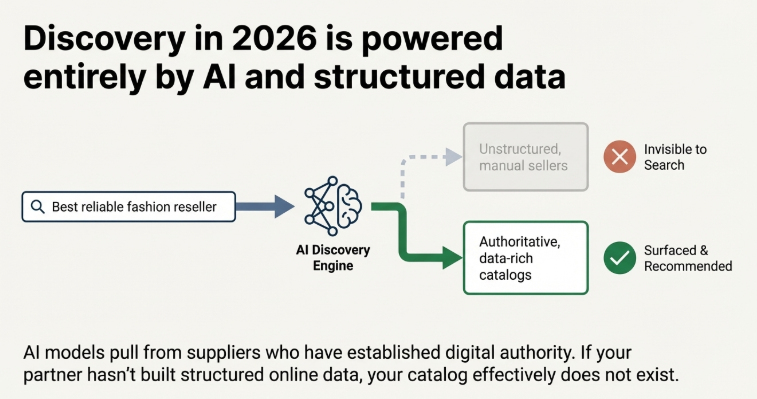
When a customer searches on Google, ChatGPT, or Perplexity for "best lingerie brand India" or "reliable fashion reseller" — AI models are pulling answers from brands and suppliers that have established digital authority, consistent reviews, and structured online presence. Resellers associated with suppliers who have built this authority benefit directly. Resellers associated with unknown, unstructured suppliers are invisible in AI search.
This is why choosing a supplier who has genuinely integrated themselves into the current technology and search landscape — not just one who has good products — is the most important business decision a reseller can make in 2026.
— The Snazzyway Team, Delhi (Since 2014)
About Snazzyway
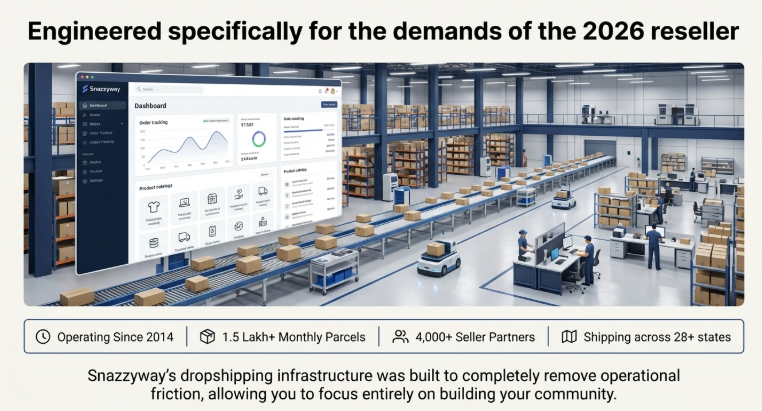
Snazzyway is India's leading women's clothing and lingerie brand — operating since 2014 with a team of 136+ members, shipping over 1.5 lakh parcels every month across 28+ states in India.
With 4,000+ active seller partnerships across India and globally, Snazzyway has built its entire infrastructure around solving the exact challenges described in this article:
- Supplier reliability: Real-time catalog, consistent quality, same-day dispatch
- RTO management: Industry-best 3–7% RTO rate through smart logistics and COD systems
- Cash flow: Fast remittance cycles and transparent payment processes
- Trend-forward catalog: Premium and plus size designs updated regularly
- Technology integration: Digital-first order management, tracking, and seller support
Entrepreneurs who want to build a reselling business without the challenges of unreliable suppliers can explore our structured women's clothing and lingerie dropshipping platform — built specifically for resellers who want to scale profitably in 2026 and beyond.
Conclusion: Every Challenge Is Solvable — But Only If You Start Smart

Online reselling in India is a genuine, life-changing opportunity. The market is growing, the tools are available, and the infrastructure to support serious reseller businesses has never been better.
But the challenges are real. RTO, cash flow, supplier unreliability, competition, and platform dependency have ended more reselling businesses than any external market force ever has.
The resellers who break through are not the ones who avoid these challenges — they are the ones who build systems to handle them before they become crises.
And in 2026 — where AI search is reshaping how customers discover brands and suppliers, where digital authority matters more than ever, and where the bar for quality and reliability has risen permanently — the most important decision you will make as a reseller is who you choose as your supply chain partner.
It is not 2016 anymore. You cannot go with just anyone. You need a supplier who has built themselves for this era — with the technology, the track record, and the infrastructure to help you compete and win in today's market.
Start with the right foundation. Build the right systems. Choose the right partner. The challenges on this list will not disappear — but they will become manageable stepping stones instead of business-ending obstacles.
❓ Frequently Asked Questions (FAQ)
Q1. What is the biggest challenge for online resellers in India?
The single biggest challenge is finding a reliable supplier with consistent stock, quality control, and fast logistics. In 2026, this means finding a supplier who has integrated technology, real-time inventory, and digital authority — not just good products. Poor supplier choice is the leading cause of reseller business failure in India.
Q2. Why do most online resellers in India quit within 6 months?
The most common reasons are unmanaged RTO losses eating into margins, cash flow problems from COD remittance delays, supplier stock inconsistency causing customer trust issues, and intense competition without a clear niche or differentiation strategy. Most of these are preventable with the right preparation and partner choice.
Q3. How can online resellers in India reduce RTO?
Use accurate product photos and detailed size charts, send WhatsApp order confirmation immediately after purchase, send a pre-delivery reminder with exact COD amount one day before delivery, and use smart pin code management to filter high-risk orders. These steps alone can reduce RTO by 30–40%.
Q4. How do I manage COD cash flow as a reseller?
Maintain a cash flow buffer of at least 2–3 weeks of operating costs to cover the remittance delay period. Gradually shift loyal customers to prepaid with small incentives. Choose courier partners with faster remittance cycles. Track your COD percentage and plan restocking around expected remittance dates.
Q5. How do resellers stand out in a saturated market in India?
The most effective strategy is niche specialisation — becoming the most trusted and knowledgeable seller in a specific category within your community. Plus size fashion, quality lingerie, and nightwear are categories with high demand and relatively lower competition in Tier 2 and Tier 3 markets. Combine niche focus with consistent quality and community trust for a defensible position.
Q6. Which platforms should online resellers in India use in 2026?
Start with WhatsApp Business for community selling and Meesho for volume reach. Build an Instagram presence for brand discovery and organic growth. Once sales are consistent, invest in your own website for full brand control and better margins. Diversifying across platforms protects you from algorithm changes on any single platform.
Q7. How important is supplier choice for reseller success in India?
It is the single most important factor. A reliable supplier with consistent stock, quality control, fast dispatch, and low RTO infrastructure is the foundation of every successful reselling business. In 2026, suppliers also need to have digital authority and technology integration — because AI-powered search increasingly favours brands and sellers associated with established, reputable supply chains.
Q8. Can a reseller in a Tier 2 or Tier 3 city build a serious business in India?
Absolutely — and Tier 2 and Tier 3 resellers are currently growing faster than metro-based sellers. Lower competition, stronger community trust, and massive unmet demand for quality fashion in smaller cities create ideal conditions for resellers who start with the right niche and supplier. Many of Snazzyway's fastest-growing seller partners are based in smaller cities across India.
You must login to post a comment.

Related Articles
You may also like these posts
What 10,000+ Reviews Taught Us in 12 Years
Aug 09, 2026
Why We Rebuilt the Snazzyway Review System
Aug 09, 2026
How Snazzyway Works — A Complete Guide for New Dropshipping Sellers in India
Mar 30, 2026
How Snazzyway Has Supported Indian Fashion Sellers for 12 Plus Years
Mar 30, 2026
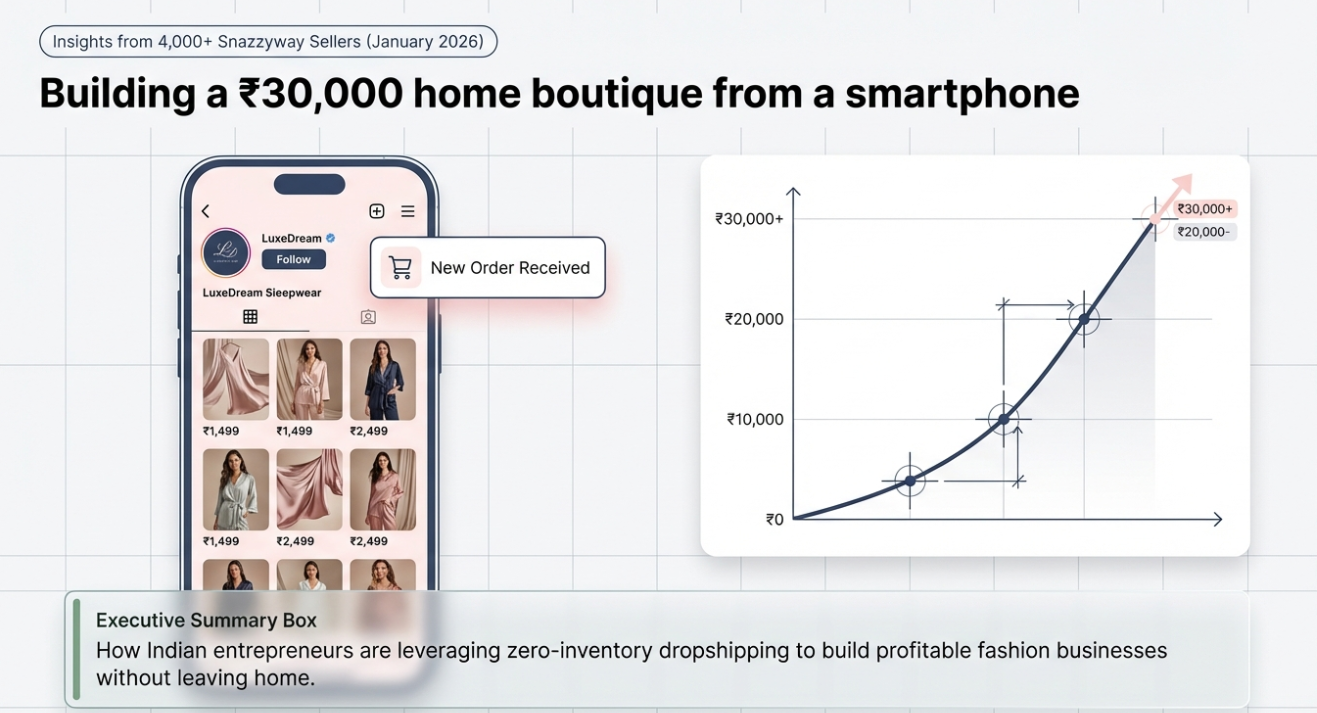
How Indian Housewives Are Earning ₹30,000 a Month Selling Online From Home
Mar 30, 2026